
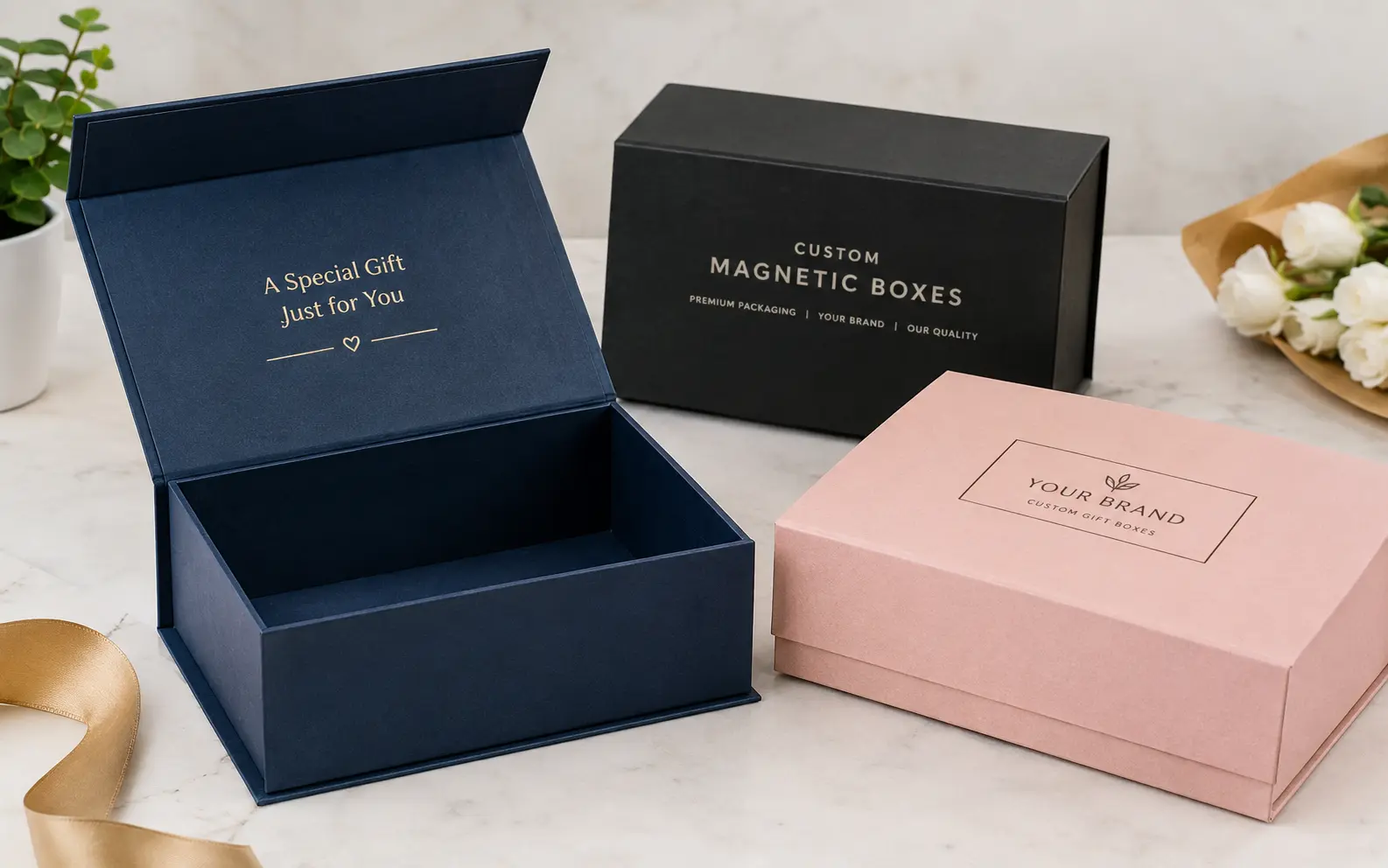
A custom magnetic gift box is a rigid or folding cardboard box that closes using a hidden magnet instead of tape, ribbon, or a tuck flap. The magnet sits inside the lid and box base, so the lid snaps shut on its own and holds without any extra sealing. Most brands choose them for the "click" moment during unboxing, but the material, magnet strength, and construction quality behind that click vary far more than any product page tells you.
I've looked through what every major packaging site says about these boxes, and they all say the same five things: premium look, secure closure, reusable, customizable, great unboxing experience. That's true, but it's also the entire conversation stopping there. What actually decides whether your box looks like a $40 gift or a $4 gift is stuff nobody puts on their homepage: magnet gauge, board thickness, glue lines, and what happens to that box after your customer is done with it. Let's get into the part that actually matters.
What's Really Inside a Magnetic Closure (And Why It Fails)
Every magnetic box uses one of two closure builds, and the difference shows up the first time someone drops the box or ships it cross-country.
Sewn-in or embedded magnets sit inside a small fabric or paper pocket that's glued between the chipboard layers before the box is wrapped. This is the standard on rigid boxes and it's durable. The magnet can't shift or peel off because it's structurally part of the wall, not stuck to the surface.
Surface-glued magnets are cheaper to produce and common on folding cartons and fast-turnaround custom runs. A small disc magnet is glued directly onto the inner liner. These work fine on a shelf, but repeated opening and closing, or a hot delivery truck, can soften the adhesive over months. I've seen this exact failure on boxes that sat in a warehouse through a summer: the magnet stayed attached to the lid but no longer aligned with the counterpart on the base, so the "snap" turned into a wobble.
If you're ordering for retail where the box gets opened and closed dozens of times (subscription boxes, reusable jewelry packaging), ask specifically whether the magnet is embedded or surface-mounted. Most suppliers won't volunteer this unless you ask by name.
Magnet Strength Isn't One-Size-Fits-All
This is the detail almost every competitor page skips entirely. Magnets used in packaging are rated in gauss or by pull force, and the strength needed depends entirely on lid weight and how the box will be handled.
- Light folding boxes (under 500g loaded) do fine with small ceramic or ferrite magnets. Cheap, adequate, and they rarely fail.
- Rigid boxes with a full flip-top lid need stronger neodymium magnets, especially if the lid is large. A weak magnet on a big flap lid means the box pops open in transit, and you'll find this out from a customer, not from your supplier.
- Drawer-style and book-fold boxes actually need less magnet strength than flip-tops because gravity and the sliding mechanism do some of the holding work already.
If your supplier's quote doesn't mention magnet type at all, that's usually a sign they're defaulting to whatever's cheapest for that box style. It's worth asking outright: "what magnet grade are you using, and is it rated for a lid this size and weight?"
Rigid vs. Folding Magnetic Boxes: The Trade-Off Nobody Explains Well
Most sites list both options side by side without saying why you'd pick one over the other. Here's the practical difference.
| Factor | Rigid Magnetic Box | Folding Magnetic Box |
|---|---|---|
| Build | Non-collapsible chipboard, wrapped in printed paper | Collapsible corrugated or paperboard, ships flat |
| Feel | Heavier, premium, book-like open | Lighter, more like a standard retail carton |
| Shipping cost (to you) | Higher, since it ships pre-assembled and takes up volume | Lower, ships flat and assembles on-site |
| Best for | Jewelry, cosmetics, corporate gifts, luxury retail | Bakery items, apparel, moderate-volume e-commerce |
| Typical minimum order | Often 100 to 500 units | Often 50 to 250 units, sometimes lower |
| Reorder speed | Slower, more tooling involved | Faster, simpler dielines |
If you're a small Etsy-style seller doing custom one-off orders, folding magnetic boxes with a pre-set dieline are almost always the smarter call. Rigid boxes make sense once you have consistent volume and a product where the box itself is part of the perceived value, think a $150 skincare set or a corporate gift with a logo.
The Sustainability Question Everyone Glosses Over
Packaging sites love to say cardboard is recyclable. True, but incomplete. The magnet is not recyclable through standard paper recycling, and it has to be manually removed before the box goes in a paper bin. Most consumers don't do this. It ends up either contaminating a recycling batch or just going to landfill intact.
If sustainability is part of your brand story, a few things actually move the needle:
- Ask for a removable magnet tab design where the magnet sits in a small paper pocket that can be peeled and pulled before disposal, rather than glued flush against the board.
- Consider FSC-certified board as the base material even if the box isn't fully magnet-free, since the board is the majority of the material by weight.
- For lower-impact runs, some suppliers now offer a friction-fit or ribbon-tie alternative on the same dieline for customers who specifically want a magnet-free option. It's worth asking if your supplier can produce both from one tooling set, since it often costs less than starting a second design from scratch.
None of the competitor pages I reviewed mention that the magnet is the actual recycling obstacle. That's the kind of detail a customer support ticket eventually surfaces, and it's better to get ahead of it in your product description or FAQ.
Real Pricing Logic (Not Just "Contact Us for a Quote")
Almost every supplier hides pricing behind a quote form, which makes it hard to know if you're being quoted fairly. Here's roughly how the cost structure breaks down, based on typical rigid and folding magnetic box runs:
- Tooling/plate setup: usually a one-time fee, often waived or reduced above 500 units. This covers the die-cut mold for your exact box shape.
- Board and magnet cost: this scales with box size, board thickness (measured in GSM or point stock), and the number of magnets (most boxes need just one, larger flip-tops sometimes use two for even pressure).
- Printing: full-color offset printing costs more per unit at low volumes but drops sharply per unit past 1,000 to 2,000 pieces. Digital printing is better for orders under 300 units since there's no plate cost.
- Finishing: foil stamping, embossing, and spot UV are priced per technique, not as a flat add-on, so stacking three finishes on a small box can double your unit cost fast.
A rough real-world range: a mid-size rigid magnetic gift box (roughly 8x6x3 inches) with one color print and a basic magnetic flip lid typically lands somewhere between $2 and $5 per unit at 500 units, and can drop under $1.50 per unit past 2,000 units. Add foil stamping or a custom insert and that easily adds $0.50 to $1.50 per box. Get itemized quotes broken into these four categories specifically, rather than accepting a single bundled number, so you can actually compare suppliers apples to apples.
The Shipping and Customs Detail That Catches People Off Guard
If you're importing magnetic boxes in bulk, especially by air freight, magnets can trigger extra screening. Loose or weakly-secured magnets are classified under dangerous goods regulations by some carriers because strong magnets can interfere with aircraft instruments if they shift during transit. This rarely affects a finished, glued-in magnetic box, but it has caused delays for shipments where suppliers used a batch of unusually strong neodymium magnets or packed loose magnet components separately.
Practical takeaway: if you're ordering a large international shipment, ask your supplier for the magnet's gauss rating and confirm it falls under standard packaging thresholds, and request that it ships as an assembled product, not with any loose components. This single question has saved people weeks of customs holdups that they never saw coming.
Common Defects to Check For Before You Accept a Bulk Order
Nobody talks about quality control on these boxes until something goes wrong. When your sample or first production batch arrives, check for:
- Magnet misalignment: close the box ten times. If it starts drifting off-center, the magnets weren't placed with enough tolerance.
- Delamination at the corners: peel gently at a corner seam. If the paper wrap lifts easily, the glue application was rushed.
- Warping on larger flat lids: bigger boxes (over 10 inches) are more prone to slight bowing if the board weight is too light for the size.
- Print registration: check that any foil or spot UV lines up exactly with the printed design underneath, especially on curved or wrapped edges.
- Inconsistent magnet pull: test a handful of boxes from different parts of the batch, not just the top of the box. Pull strength can vary if the supplier used mixed magnet stock.
Catching these in a pre-production sample, rather than a full run, is the single best money-saving habit in this entire category.
Matching the Box Style to the Actual Gift
This sounds obvious, but I still see brands default to the same flip-top rigid box regardless of product. A few pairings that actually work better than the default:
- Jewelry and watches: a book-style rigid box with an interior foam or velvet insert, magnetic closure on the long edge so it opens like a hardcover.
- Bakery and food gifts: a folding magnetic box with a food-safe interior liner, since rigid boxes add unnecessary bulk and cost for single-use food packaging.
- Apparel and subscription boxes: a drawer-style magnetic box, since customers tend to reuse these for storage and the sliding mechanism holds up better under repeated use than a hinge.
- Corporate and bulk gifting: a mid-weight folding magnetic box with a printed interior, since the cost per unit needs to stay reasonable across dozens or hundreds of recipients.
Quick Comparison Before You Order
| Question to Ask Supplier | Why It Matters |
|---|---|
| Embedded or surface-glued magnet? | Determines long-term durability |
| What's the magnet's gauss/pull rating? | Prevents weak closures on larger lids |
| What board weight (GSM/point) are you using? | Affects rigidity and warping risk |
| Can I get a pre-production sample? | Catches defects before a full run |
| Is the magnet removable for recycling? | Matters if sustainability is part of your pitch |
| How is it packed for international shipping? | Avoids customs delays tied to magnet classification |
Frequently Asked Questions
Are magnetic gift boxes reusable?
Yes, and this is one of their biggest selling points over tuck-flap boxes. As long as the magnet is embedded rather than surface-glued, the box can be opened and closed hundreds of times without losing its snap.Can magnetic gift boxes go through airport security or mail scanners without issues?
Individual consumer packages are fine. The concern only applies to bulk commercial shipments of loose or high-strength magnets, which some carriers flag under dangerous goods rules. A finished, assembled box is not treated the same way.What's the minimum order quantity for custom magnetic boxes?
It depends heavily on style. Folding magnetic boxes can sometimes be ordered in quantities as low as 25 to 50 units through print-on-demand style suppliers. Rigid magnetic boxes usually start around 100 to 500 units because of tooling costs.Do magnetic boxes cost a lot more than regular gift boxes?
Expect roughly 15% to 40% more per unit compared to a basic tuck-top box of the same size, mostly due to the magnet component and the extra assembly step. The gap narrows significantly at higher order volumes.Can I get magnetic boxes without any printing, just plain kraft or colored stock?
Yes, most suppliers offer blank or single-color stock magnetic boxes with no minimum design work, which is a good option if you're testing a product line before investing in full custom printing.How do I know if my product is too heavy for a magnetic closure?
As a rough guide, if your packed product exceeds 2 to 3 pounds and sits inside a large flip-top lid, ask specifically for a reinforced or dual-magnet closure. Standard single-magnet builds are rated for lighter contents.Is there a magnet-free alternative that still looks premium?
Yes. Ribbon-tie closures, friction-fit lids, and Velcro-style closures can often be produced from the same box dieline. They're worth considering if sustainability messaging matters to your brand.