
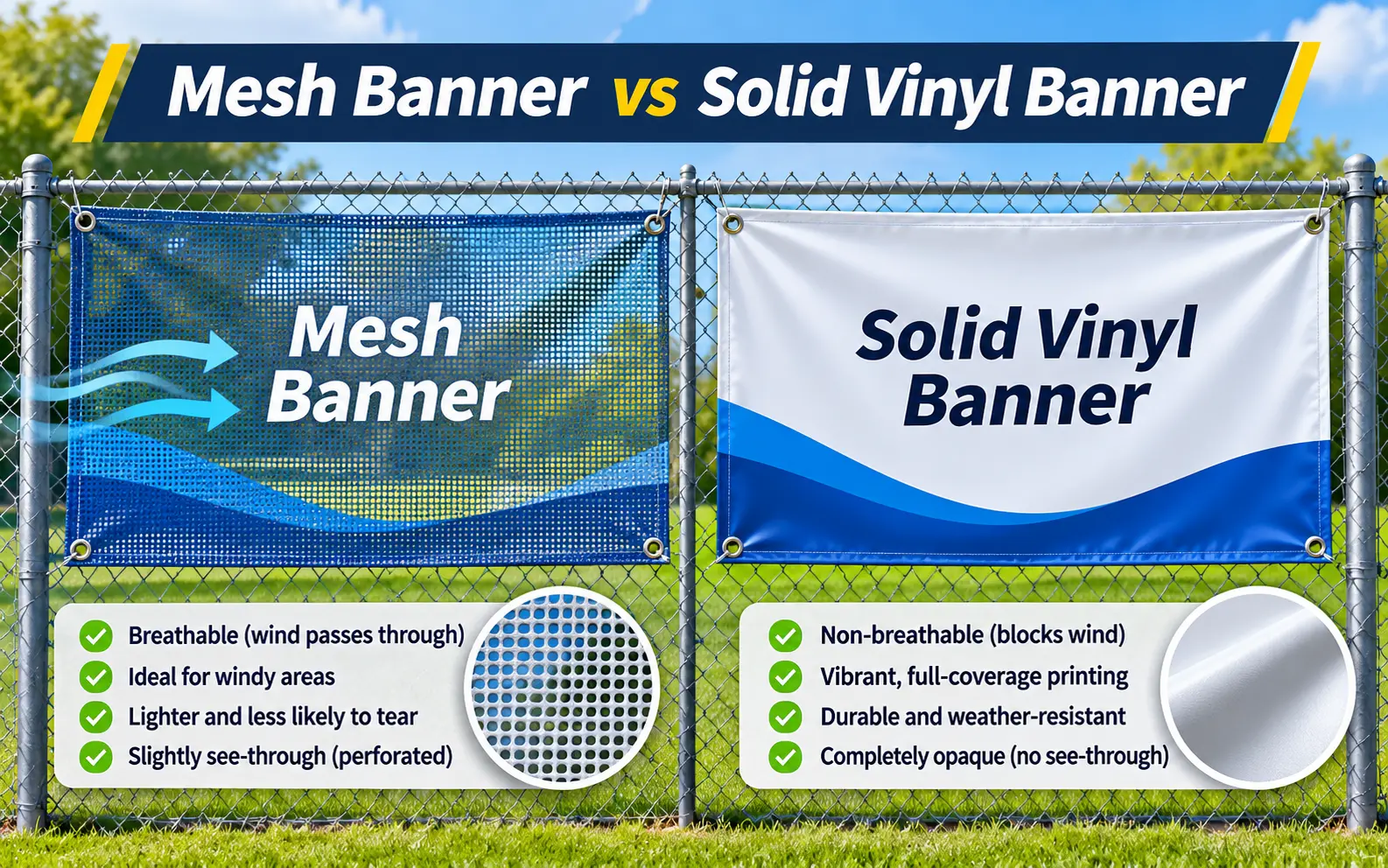
We hear this question at the print counter almost every week. Usually it comes after something has already gone wrong: a banner ripped off a fence in the first storm, or a pricey mesh print that looked faded and dotty in a hotel ballroom.
Picking between a mesh banner and a solid vinyl banner is not a style choice. It’s a site decision. Here’s the short version, then the details we’ve learned the hard way.
Choose a mesh banner when it hangs outdoors on a fence, scaffold, or building face where wind can hit it directly, especially anything larger than about 32 square feet. Choose solid vinyl for indoor use, sheltered walls, close-up viewing, photos, fine text, or double-sided printing, because its unbroken surface prints sharper and blocks light completely. Mesh is PVC-coated polyester with roughly 30% open area, while solid vinyl is a continuous 13 to 18 oz PVC sheet.
Mesh vs Solid Vinyl Banner: Spec Sheet Side by Side
This is the table we keep pinned next to the quoting desk. Exact figures shift a little between media brands, so treat these as working ranges.
| Factor | Mesh banner | Solid vinyl banner |
|---|---|---|
| Material weight | 8 to 10 oz per sq yd (about 270 to 340 gsm) | 13 oz standard, 15 to 18 oz blockout (about 440 to 610 gsm) |
| Open area | About 30% (70/30 weave) | 0% |
| Sharpness at under 10 ft | Visible dot pattern | Photo-grade detail |
| Smallest text we’d print | 2 in tall | About 1 in for close reading |
| Opacity | See-through, light bleeds through | Opaque; blockout stops all light |
| Double-sided printing | Not practical | Yes, on 15 to 18 oz blockout |
| Wind behavior | Little billowing, steadier loads | Sails and flaps unless tensioned hard |
| Rain | Passes through | Sheds water; can pool if it sags |
| Typical exposed lifespan | 12 to 24 months | 2 to 5 years (13 oz), 5+ (18 oz) in calm sites |
| Price per sq ft | Similar to slightly higher | Baseline |
| Flame-retardant versions | Available | Available |
The lifespan row only holds where each material is used correctly. Put solid vinyl on an exposed fence and it can fail in a week.
What Wind Actually Does to a Banner (With Numbers)
“It acts like a sail” is true, but it doesn’t tell you how much force your fence or grommets will see. The standard sign-industry starting point is simple: wind pressure in pounds per square foot equals 0.00256 × wind speed (mph) squared.
Here’s what that means for a common 4 x 8 ft banner (32 sq ft) with 12 grommets on 2 ft spacing:
| Wind speed | Pressure on solid face | Total load on 4 x 8 ft | Load per grommet (shared evenly) |
|---|---|---|---|
| 15 mph (breezy day) | 0.58 psf | 18 lb | 1.5 lb |
| 25 mph (gusty afternoon) | 1.6 psf | 51 lb | 4.3 lb |
| 40 mph (storm gust) | 4.1 psf | 131 lb | 11 lb |
| 60 mph (severe gust) | 9.2 psf | 295 lb | 25 lb |
Those are baseline figures. Shape factors and gusting commonly push real loads 50% higher or more, and the load never spreads evenly. Corners and top edges take the worst of it.
Why 30% open area doesn’t mean 70% less force
This is the part almost every guide gets wrong. A 70/30 mesh still blocks most of the wind hitting it, so it still carries a large share of the load. We never treat mesh as “wind-proof” on a quote.
What mesh really changes is behavior. Solid vinyl balloons, then snaps flat when a gust drops, and each snap hits the grommets like a hammer. Mesh stays flatter and loads steadily. That difference in shock loading, not the raw pressure number, is what keeps mesh banners attached.
How banners actually fail
- Corner grommet pull-out: The top corners tear first on nearly every failed banner we’ve repaired. Flapping fatigue does it, not one big gust.
- Hem separation: A folded hem with no reinforcement peels open, then the grommets go one by one.
- Fence toppling: On rented temporary fence panels, a banner turns an open chain-link panel into a wall. Mesh lowers the risk but doesn’t remove it; we still tell clients to brace or sandbag every second panel.
- Hardware snapping: Cheap zip ties go brittle in UV and fail before the banner does.
Skip the wind slits
Half-moon cuts in solid vinyl were standard advice for years. In our experience they relieve very little pressure, and every cut is a starting point for a tear. If a site needs wind relief, order mesh instead of slicing up solid vinyl.
Print Quality: Where the Holes Start to Show
The perforation pattern is obvious from 5 feet and invisible from 25. Somewhere around 10 to 15 feet, most people stop noticing it. So the real question isn’t “is mesh sharp enough?” It’s “how close will people stand?”
Size your text to the viewing distance
Our working rule on solid vinyl is 1 inch of letter height for every 10 feet of viewing distance. On mesh, we add about 25% and never go below 2 inches. A fence wrap read from a sidewalk 30 feet away needs letters of at least 3 to 4 inches.
What sits behind the mesh changes the colors
Nobody mentions this, yet it’s the most common surprise at install. Mesh shows a little of whatever is behind it.
- Bright sky behind a scaffold wrap: Colors look washed out and lighter by a noticeable margin, especially yellows and pastels.
- Dark building or shaded wall behind: Colors read richer and contrast improves.
- Glass windows behind: Occupants can see out, which is why mesh is the go-to for wraps over occupied offices.
We push saturation slightly on mesh art and favor dark backgrounds with light text when the sky will be behind it.
Ask whether your mesh is printed on a liner
On unlined mesh, some ink passes through the holes and lands on the printer bed or leaves a faint ghost image on the back. Printing with a liner keeps the reverse clean and the front density even. If the back of your banner will face a public street, ask your printer which method they use.
The indoor exception
Mesh usually looks dull indoors under spotlights. Stage backdrops are the exception: speakers can sit behind a 70/30 mesh scrim because sound passes through, and the backdrop doesn’t billow when the PA pushes air.
Which One Fits Your Job? Real Scenarios From Our Orders
Before any quote, we ask three questions. They settle about nine out of ten orders.
- Exposure: Can wind hit the full face of the banner, with nothing behind it to shield it?
- Distance: Will anyone read it from closer than 10 feet?
- Light and sides: Does it need to block light, be backlit, or show different art on each side?
A “yes” to the first points to mesh. A “yes” to either of the others points to solid vinyl. Two conflicting answers mean a site visit or a photo of the location.
Jobs where we specify mesh
- Construction fence wraps: Long runs on 6 ft chain-link, often 100 ft or more. Mesh with grommets every 12 to 18 inches, plus bracing on rented panels.
- Scaffold wraps: Many sites won’t allow anything else. We also supply a flame-retardant certificate when the contractor asks.
- Sports field and stadium sponsor banners: Mesh survives a full season on open outfield fences where solid vinyl rarely does.
- Outdoor festival stage backdrops: Mesh handles both the wind and the sound system.
- Building wraps over occupied floors: People inside keep their view and some daylight.
- Rooftop or highway-facing banners: Mesh, plus anchors rated by someone who has run the load numbers.
Jobs where we specify solid vinyl
- Storefront banners mounted flat to a wall: The wall blocks wind from behind, so 13 oz vinyl prints sharper and costs less.
- Trade shows and conferences: Matte solid vinyl kills glare under hall lighting. Most venues want proof of flame resistance.
- Step-and-repeat and photo backdrops: Cameras pick up the mesh pattern instantly.
- Double-sided pole banners: 15 to 18 oz blockout so the reverse art doesn’t ghost through.
- One-weekend events in sheltered spots: A courtyard or covered entry doesn’t need mesh.
- Party and celebration banners: Read up close, usually indoors, and nobody wants a see-through birthday banner.
The gray zone
A 3 x 6 ft banner zip-tied to a porch railing in a gusty suburb is the classic borderline case. We usually go solid vinyl with tight tensioning and bungees, because the size is small enough that the loads stay manageable. Scale that same location up to 4 x 12 ft and we switch to mesh.
Installation and Finishing: The Details That Decide Lifespan
We’ve seen a cheap banner outlast a premium one simply because it was hung properly. Material choice gets you halfway; finishing and install get you the rest.
- Grommet spacing: 24 inches is the default on most orders. For any exposed outdoor banner, we drop to 12 to 18 inches so each grommet carries less load.
- Webbing-reinforced hems: On large mesh, ask for polyester webbing sewn into the hem. A plain folded hem is the first thing to peel on a fence line.
- Tension: A loose banner flaps, and flapping kills banners. Pull it taut in both directions until the face can’t ripple.
- Ball bungees as a safety fuse: Bungees stretch in a gust and absorb shock. In a true storm, a bungee gives way before the fence or frame does, which is exactly what you want.
- UV-rated ties: Standard nylon zip ties turn brittle within a season of strong sun. Use black UV-stabilized ties and check them every few months.
- Grommets lined up to posts: Measure post spacing and send it with the order. Mesh can vary by up to about half an inch per linear foot, so ordering to an exact fence width often leaves grommets landing between posts.
- Pole pockets for solid vinyl: When a banner hangs between two rods, pockets spread the load along the whole edge instead of a few points.
- Safe anchor points: Gutters, downpipes, and balcony railings were never designed for 100+ lb of sideways pull. Anchor to structure.
Cost, Lifespan, Fire Rating, and the Stuff Nobody Mentions
Price is rarely the deciding factor
Per square foot, the two materials usually land within 10 to 25% of each other, depending on the printer. The bigger costs sit elsewhere: reprints, a damaged fence, or a crew sent back out to rehang a banner. Run the math on a replacement before choosing solid vinyl to save a few dollars on an exposed site.
Why lifespan claims conflict online
You’ll find guides saying mesh lasts longer and others saying vinyl does. Both are right, and here’s why. In a calm, sheltered spot, solid vinyl outlives mesh because more of its surface holds ink and its thicker coating shrugs off UV. On an exposed fence, mesh outlives solid vinyl because the solid banner tears itself apart long before UV becomes the issue.
Climate shifts these numbers a lot. In hot, high-UV regions, expect the low end of every range. Near the coast, salt air corrodes cheap grommets faster than it hurts the print.
Fire ratings for venues and scaffolds
Indoor venues, malls, and many scaffold contractors ask for flame-retardant media with paperwork. In the US the common standard is NFPA 701; in much of Europe it’s B1 (DIN 4102-1). Both mesh and solid vinyl come in certified versions. Ask for the certificate at the time of ordering, because event managers often want it before load-in.
Sustainability: neither is the green option
Mesh is sometimes described as more eco-friendly, but it’s PVC-coated polyester, chemically the same family as solid vinyl. It does use less material per square foot. Neither goes in curbside recycling. Practical steps that help: reusable designs with no dates, proper storage for multi-season use, or PVC-free polyester and polyethylene media where your printer offers them.
Storage between uses
- Solid vinyl: Roll it, print side out, around a tube at least 3 inches across. Folding leaves creases that rarely come out fully.
- Mesh: Tolerates folding better, but rolling still keeps it flatter for the next install.
- Both: Dry completely before storing to prevent mildew spots, and keep away from heat sources.
Mistakes We See Over and Over
Most banner failures we’re asked to fix trace back to one of these. All of them are avoidable at the ordering stage.
- Solid vinyl on a fence “because it looks sharper”: Nobody reads a fence banner from 3 feet. The sharpness gain is invisible at sidewalk distance, but the wind risk is very real.
- Shrinking text on mesh to fit more words: A logo, a headline, and a phone number or URL is plenty. Long taglines on mesh become grey noise.
- Treating mesh as “no bracing needed”: Mesh reduces load; it doesn’t erase it. Temporary fences still need support.
- Double-sided printing on 13 oz: Backlight from the sun makes the reverse art ghost through. Pay for blockout.
- Zip ties cinched with zero give: Rigid ties transfer every gust straight into the grommets. Leave a little play or use bungees.
- Ordering mesh for a ballroom: It looks faded under event lighting and costs more than the solid vinyl that would look better.
- No photo of the site: A 10-second phone photo of where the banner will hang prevents most wrong-material orders.
Frequently Asked Questions
Is a mesh banner waterproof?
The material itself is waterproof, since the coating is PVC. Rain simply passes through the holes rather than soaking in, so mesh won’t rot, hold water weight, or stay soggy after a storm.
Can you write on a vinyl or mesh banner with a marker?
Solid vinyl takes oil-based paint markers well, which is handy for adding dates or prices on site. Mesh is a poor surface for handwriting because the ink skips across the holes.
What artwork resolution do I need for a large mesh banner?
At full size, 100 to 150 dpi is plenty for most mesh banners, because nobody views them closely. Send logos and text as vector files (PDF, AI, or EPS) so edges stay crisp at any scale.
Can a mesh banner be backlit like a lightbox sign?
Not effectively. Light pours through the holes and washes out the print. Backlit signs use a translucent solid flex material made specifically for illumination.
Do I need a permit to hang a large banner on a building?
Often, yes. Many cities treat building wraps and large scaffold banners as outdoor advertising, which can require a permit and sometimes a fire-rating certificate. Check with your local building or planning office before printing.
How do I clean a vinyl banner without damaging the print?
Use lukewarm water, mild dish soap, and a soft cloth or sponge. Skip solvents, abrasive pads, and high-pressure washers, which can lift ink and scuff the surface.
Is 10 oz vinyl good enough for an outdoor banner?
For a short promotion of a few weeks in a sheltered spot, it works fine. For anything exposed or longer-term, 13 oz is the sensible minimum, and 18 oz blockout suits multi-year or double-sided installs.