
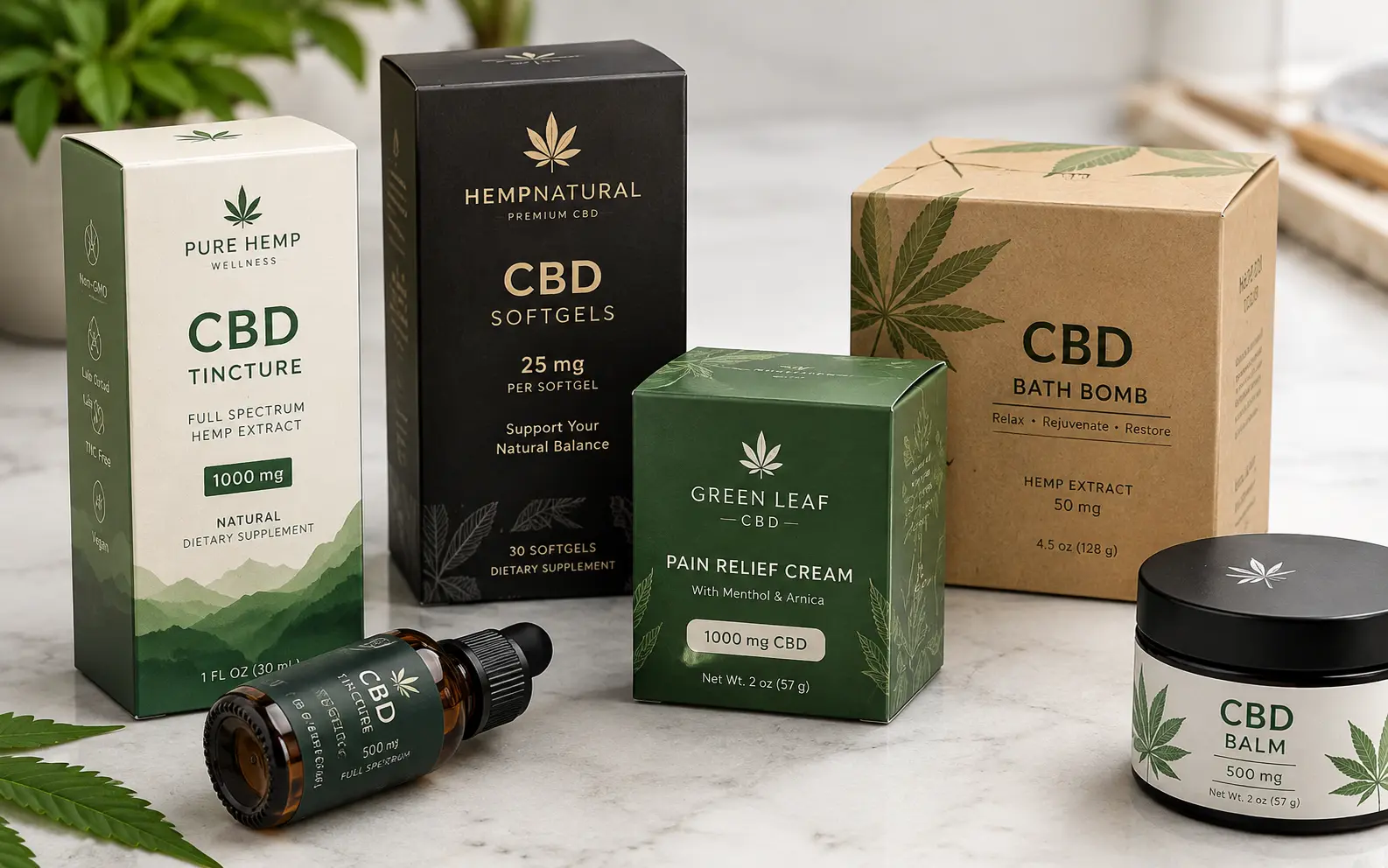
Custom CBD boxes are packaging built to your exact product dimensions, brand colors, and print specs, designed to shield cannabinoid products from light, oxygen, and moisture while meeting state labeling and child-resistant requirements. The right box does three jobs at once: it protects the product's potency, keeps you legally compliant, and makes someone want to buy it again. Get any one of those wrong and the other two stop mattering.
I've looked at what most packaging sites tell you about CBD boxes, and honestly, a lot of it repeats the same three points: pick a material, pick a finish, get a quote. That's not wrong, it's just incomplete. Below is what actually changes the outcome of your packaging order.
Why CBD Packaging Behaves Differently Than Regular Retail Boxes
Cannabinoids degrade. That's the part most guides skip entirely.
CBD oil exposed to UV light and oxygen starts breaking down into cannabinol (CBN), a compound with weaker effects and a different potency profile than what's on your label. A box that looks great but doesn't block light is quietly shortening your product's shelf life every day it sits on a shelf or in a warehouse.
Here's what actually protects potency:
- UV-blocking coatings or opaque stock stop light-driven degradation, especially important for tinctures in clear glass bottles.
- Tight-fit inserts stop bottles from rattling and micro-cracking caps during shipping, which lets in oxygen.
- Moisture-resistant liners matter more for edibles and capsules than most brands realize; humidity swings inside a warehouse can soften gel caps or clump gummies.
If your supplier only talks about "premium cardboard" and never mentions light exposure or barrier coatings, they're selling you a pretty box, not a functional one.
What Custom CBD Boxes Actually Cost (And Why Quotes Vary So Much)
Every packaging site shows a "starting at" price and calls it a day. Here's the actual math behind that number.
Price per unit depends on four things stacked together: base material, print complexity, order volume, and finishing add-ons. A plain one-color kraft box at 1,000 units might land around $0.60 to $0.90 each. Add full-color CMYK printing, a gloss lamination, and foil stamping on the same box, and you're often looking at $1.40 to $2.50 each at that same volume.
The volume curve matters more than most brands expect:
| Order Quantity | Typical Price Range (per box)* | What Changes |
|---|---|---|
| 100–250 units | $1.50–$3.00 | Digital printing, higher per-unit setup cost |
| 500–1,000 units | $0.80–$1.80 | Offset printing becomes viable, plates amortized |
| 2,500–5,000 units | $0.45–$1.10 | Bulk material discounts kick in |
| 10,000+ units | $0.25–$0.70 | Lowest per-unit cost, best for established SKUs |
Ranges vary by supplier, material, and finish; treat this as a planning baseline, not a quote.
One thing nobody tells new brands: die-cutting a custom structural shape (not just a standard tuck box) usually adds a one-time tooling fee of $150 to $400. That fee is often waived or reduced if you're ordering above a few thousand units, so it's worth asking directly rather than assuming it's baked in.
Materials: Matching Stock to What's Actually Inside the Box
Most competitor pages list kraft, rigid, and corrugated as options and stop there. The real question is which material solves your specific packaging problem.
Paperboard (SBS or CCNB), 16pt to 24pt thickness
This is the workhorse for tinctures, capsules, and small edibles. Thicker stock (20pt+) holds its shape better for boxes with inserts and resists denting during transit. For reference, most premium retail CBD boxes run 18pt to 20pt.Corrugated board
Better for shipping-heavy products like beverage cases or subscription boxes going straight to a customer's door without secondary shipping packaging. The fluting adds cushioning that flat paperboard can't match.Rigid (setup) boxes
Used for higher-priced product lines, gift sets, and anything positioned as premium. They cost more per unit but hold their shape permanently, no folding creases, which matters for retail shelf presence.Kraft stock
Popular for the "clean, natural" branding angle, but plain kraft alone offers weak light protection unless it's paired with an interior foil or metalized liner. If you're using kraft for brand aesthetics, ask your supplier about adding a light-blocking layer rather than assuming the brown color itself does that job.Choosing a Box Style That Fits How the Product Is Actually Handled
Style choice isn't just visual. It's about how the product gets picked up, opened, and re-closed.
- Tuck-end boxes work well for single-item retail sales but aren't ideal if customers reopen the box repeatedly; the tuck flaps wear out.
- Sleeve and tray boxes create a stronger unboxing moment for gift-tier products but cost more to produce.
- Hinged-lid boxes are the best fit for products customers use daily, like capsule bottles, since they open and close cleanly hundreds of times.
- Display/counter boxes double as point-of-sale fixtures for dispensaries and retail counters, saving the retailer a step and increasing your shelf visibility.
If you're not sure which fits, think about the last action the customer takes before use. A single-use tincture sold once needs less structural durability than a daily-use capsule bottle a customer opens every morning for a month.
Compliance Details Most Guides Gloss Over
Every packaging company mentions "labeling compliance," but few explain what actually trips brands up.
Child-resistant packaging isn't optional in most states, and it's not just about having a hard-to-open box. In states requiring it, the packaging typically needs to meet the same performance standard used for pharmaceuticals under 16 CFR 1700.20, meaning it has to pass an actual test showing most children under five can't open it within a set time, while adults can. A box that's simply "hard to open" without that certification doesn't count in states that enforce this rule.
State rules genuinely contradict each other. California restricts cartoon imagery and youth-appealing design. Other states focus more heavily on mandatory warning statement wording and font size minimums. If you sell across state lines, a single packaging design that satisfies every state simultaneously is rare, most multi-state brands run region-specific label inserts rather than redesigning the whole box per state.
FDA warning letters are a real pattern worth watching. The FDA has repeatedly sent warning letters to CBD brands over unapproved health claims printed directly on packaging, things like disease-treatment language or unsubstantiated wellness claims. If your packaging copy makes any medical claim, even implied ones like "relieves chronic pain," that's the single most common compliance issue that gets brands flagged, more common than material or labeling font issues combined.
Retail and marketplace requirements add another layer. If you're selling through Amazon or another marketplace with its own packaging policy, or supplying dispensaries, you may need to meet their specific inventory and barcode placement rules on top of state law. Always confirm with the retailer directly before finalizing print files, since their requirements can be stricter than state minimums.
Design Choices That Influence Repeat Purchases
Packaging affects reorder rates more than most CBD brands account for in their budget.
- Consistent color-coding across a product line (different strength tinctures in different accent colors, for example) reduces customer confusion and returns from someone grabbing the wrong potency.
- A visible dosage or mg count on the front panel, not buried on a side panel, cuts down on customer support questions about strength.
- QR codes linking to third-party lab results (COAs) build more trust than any amount of packaging copy. This has become close to an unwritten industry standard: brands that skip it now look less credible by comparison, even if their product quality is identical.
- Tactile finishes (soft-touch lamination, embossed logos) genuinely increase perceived product value in unboxing research, but they add cost and slightly slow production, so reserve them for your flagship SKU rather than every product in the line.
Mistakes That Show Up After the Order Ships
A few practical issues come up often enough to flag before you finalize artwork:
- Ordering a box sized exactly to the bottle with zero tolerance. Bottles and boxes both have manufacturing variance; a box cut to the exact bottle dimension often won't close properly once you're at scale. Build in 1–2mm of clearance.
- Choosing matte lamination for products stored in humid climates. Matte finishes can show fingerprints and moisture spotting more visibly than gloss or soft-touch, which matters if your product ships to coastal or high-humidity regions.
- Skipping a physical sample before bulk production. Digital proofs don't show you how foil catches light, how a hinge folds after 50 openings, or how a color actually prints on your chosen stock. A $30–$60 physical sample can save you from a $2,000 mistake.
- Not confirming child-resistant certification paperwork exists, not just the feature. Some suppliers use "child-resistant style" boxes that were never actually lab-certified. Ask for the certification report, not just a verbal confirmation.
How to Evaluate a CBD Packaging Supplier
Before committing to an order, a short vetting process saves real money:
- Ask for their MOQ range and how pricing scales. A supplier that only shows one number without a volume breakdown is harder to budget against long-term.
- Request a physical sample of a similar box, not just a photo. Feel the stock weight and check the fold lines.
- Confirm turnaround time in writing, including whether it starts after design approval or after payment. These can be several days apart.
- Ask directly about compliance experience with your specific state. A supplier that's only shipped to non-regulated retail industries may not know the CBD-specific rules well.
- Check for a compliance guarantee or revision policy if a design element gets flagged after printing. Reputable suppliers will flag risky claims before production, not after.
Sustainable CBD Packaging: What's Actually Meaningful vs. Marketing
"Eco-friendly" gets used loosely in this industry. A few distinctions worth knowing:
- FSC certification means the paper came from responsibly managed forests, it says nothing about recyclability or the box's final footprint on its own.
- Post-consumer recycled (PCR) content is more measurable: a box made with 30% PCR fiber has a documented lower raw-material footprint than one that's simply "recyclable" but made from 100% virgin pulp.
- Right-sizing (fitting the box closer to the actual product instead of using oversized stock boxes) cuts material use and shipping cost simultaneously, and it's the change most brands underuse simply because it requires a custom die rather than a stock box size.
If sustainability matters to your customer base, PCR content percentage and right-sized dimensions are more concrete talking points on your own packaging than the word "eco-friendly" alone.
Frequently Asked Questions
How long does it take to get custom CBD boxes made?
Standard production typically runs 10 to 15 business days after art approval, not from when you place the order. Rush options can cut this to 5 to 7 days for an added fee, but always confirm whether rush pricing includes shipping time or just production.What's the minimum order quantity for custom CBD packaging?
Most suppliers set MOQs between 50 and 250 units for custom printed boxes, though per-unit cost drops sharply above 1,000 units. Digital printing supports low MOQs; offset printing needs higher volume to be cost-effective.Do CBD boxes need to be child-resistant by law?
It depends on your state and product type. Several states legally require child-resistant packaging for CBD and cannabis-adjacent edibles and tinctures, while others leave it to brand discretion. Check your specific state's cannabis or hemp regulatory agency before finalizing box structure.Can I put THC content or health claims on my CBD box?
You can state THC percentage where required (usually to confirm it's under the legal 0.3% threshold), but avoid any language implying the product treats, cures, or prevents a medical condition. This is the most common reason CBD brands receive FDA warning letters.What's the difference between CBD boxes and general hemp packaging?
"Hemp packaging" is a broader term covering any product derived from the hemp plant, including fiber goods and non-cannabinoid items. "CBD packaging" specifically applies to products containing cannabidiol, which triggers the labeling and child-resistant rules discussed above; general hemp fiber products usually don't.How do I know what size box I need for my CBD product?
Measure your primary container (bottle, jar, or blister pack) at its widest points, then add 1 to 2mm of clearance per side for the box interior. If you're including an insert or extra literature, account for that thickness separately rather than assuming it fits automatically.Is kraft packaging strong enough to protect CBD oil from light?
Plain kraft board provides some opacity but isn't a dedicated UV barrier. For light-sensitive tinctures, ask about an interior metalized liner or foil layer added to the kraft exterior, which keeps the natural look while adding real light protection.