
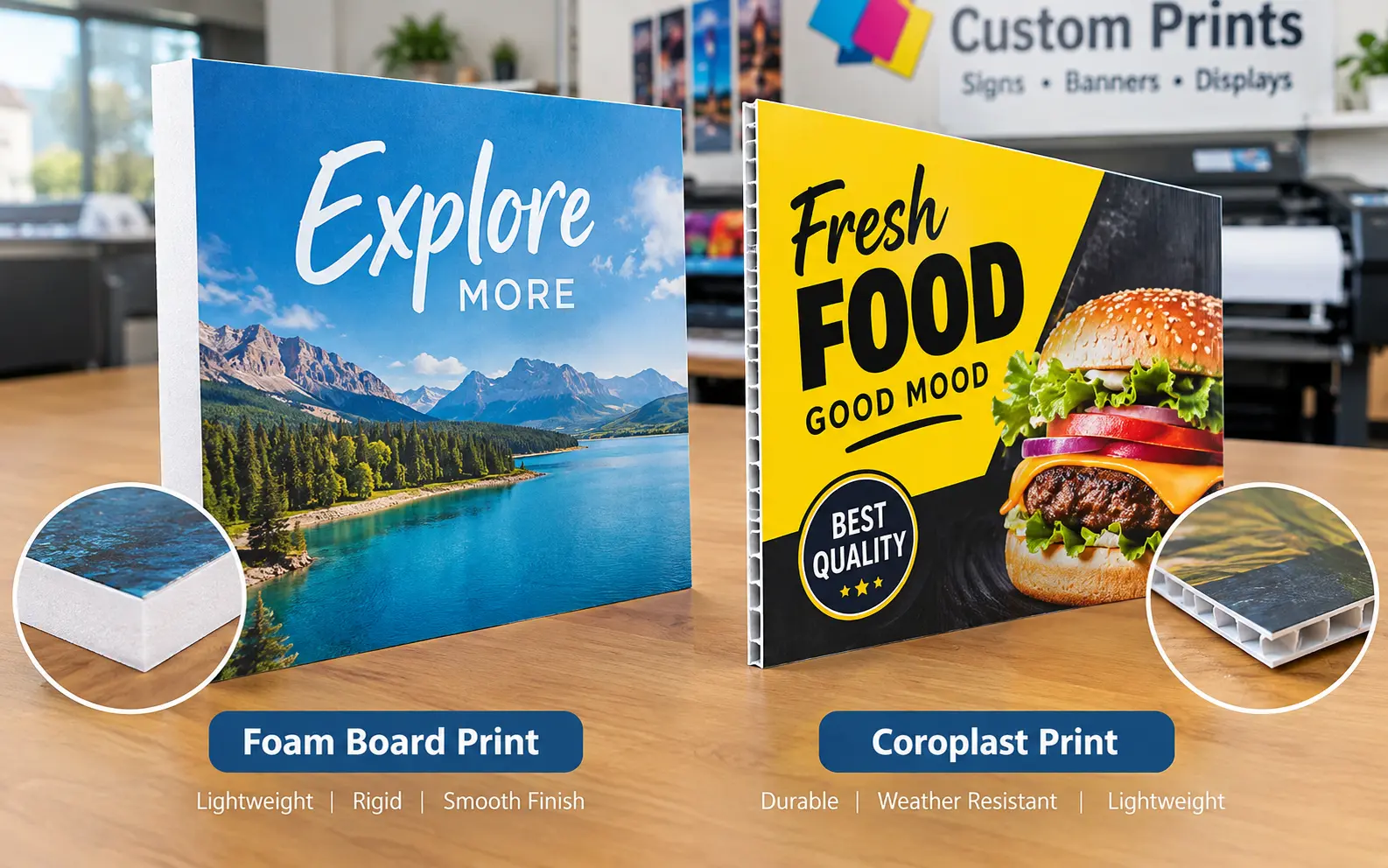
Choose foam board for indoor, short-term displays where a smooth, crisp print surface matters. Choose coroplast for anything outdoors, anything that will get handled roughly, or any sign that needs to last more than a few days. Foam board is the better-looking surface. Coroplast is the better-surviving one.
I have reprinted more signs than I like to admit because someone picked the wrong board. Almost every case came down to one question: where will this sign sit at 3 p.m. on its worst day?
This guide skips the textbook basics and focuses on what actually decides the order: failure points, print quirks, mounting, and cost over the sign's real life.
Where Each Material Fails First
Every rigid board has a weak spot. Knowing it saves you a reprint.
Foam board fails at the surface. The paper facing absorbs moisture, bubbles, and lifts away from the core. A trade show booth in an air-conditioned hall is fine. A lobby sign near a door that opens to rain is not.
Coroplast fails at the edges and corners. Hard knocks can crease the flutes, and a deep crease never fully flattens. Cold weather makes the plastic stiffer and more likely to crack at a fold.
- Dents: Foam board crushes under a fingernail or a stacked box. Coroplast springs back from most pressure.
- Humidity: A foam board left in a damp garage for a week can curl before you ever hang it.
- Sunlight: Direct sun on a car dashboard or south-facing window can warp foam board within days.
- Wind: Coroplast flexes and survives gusts. Foam board snaps.
What Your Print Actually Looks Like
This is the gap I see competitors skip most often. The substrate changes the finished image, not just the sign's toughness.
Foam board gives you a flat, uniform surface. Photos, fine text, and gradients look clean because nothing underneath interferes. That is why it dominates photography displays, real estate presentation boards, and memorial boards.
Coroplast has parallel flutes running inside the sheet. On a thin print or a light solid color, you can sometimes see faint horizontal or vertical ridges, especially in raking light. Dark, saturated colors hide this well. Large pastel fields show it most.
- Flute lines: Design with bold colors and avoid big flat pastel backgrounds if image quality matters.
- Fine detail: Keep body text above roughly 24 pt on yard-sign sizes so it stays readable from the road anyway.
- Gloss: Matte finishes hide surface texture better than glossy ones on both materials.
Flute Direction Decides Whether Your Stake Fits
This one catches first-time buyers constantly. Coroplast flutes run in one direction only, and wire H-stakes slide into the flutes.
If you order a 24" x 18" sign with flutes running the wrong way, the stake cannot go in without drilling or taping. Always confirm flute direction with your printer before the proof is approved.
For vertical stake mounting, flutes should run top to bottom. For wide banners hung with zip ties, direction matters less.
Real Scenarios: What I Would Order
Matching the board to the job is easier than comparing specs.
- Political or real estate yard signs: Coroplast, 4 mm, flutes vertical, H-stake included.
- Garage sale or one-day event: Coroplast is still the safer choice, since rain pops up without warning.
- Trade show tabletop display: Foam board, 3/16", because it looks sharper and nobody is leaving it outside.
- Photo mounting for a gallery or wedding: Foam board, ideally with a laminate to resist fingerprints.
- Construction site notices: Coroplast, often drilled or grommeted at the corners for zip ties.
- Classroom or office wayfinding: Either works. Foam board looks neater, coroplast lasts through a school year of bumps.
Cost Over the Life of the Sign
The sticker price rarely tells the full story. Per square foot, the two materials often land close together at low volume. Coroplast tends to get noticeably cheaper in bulk, which is why campaign and contractor orders favor it.
The hidden cost is replacement. A foam board sign used outdoors can need replacing after a single rain. A coroplast sign can last a season or more in the same spot.
| Factor | Foam Board | Coroplast |
|---|---|---|
| Best location | Indoor | Indoor and outdoor |
| Print surface | Smooth, no texture | Slight flute texture possible |
| Weather tolerance | Poor | Good |
| Impact behavior | Dents and crushes | Flexes, may crease |
| Typical lifespan outdoors | Days | Months to a couple of years |
| Bulk pricing | Moderate | Usually lower |
Mounting and Handling Tips I Wish Someone Told Me Earlier
How you hang the sign matters as much as what it is made of.
- Foam board: Use removable mounting tape or an easel back. Pins and heavy adhesive tear the paper face.
- Coroplast: Zip ties through pre-drilled holes or grommets hold up best in wind.
- Transport: Stack foam board flat with cardboard between sheets. Coroplast can be bundled, but avoid folding it.
- Storage: Keep both flat and out of heat. Leaning a sheet against a wall for weeks causes a permanent bow.
When Neither Is the Right Answer
Sometimes both boards are a compromise. If you need a smooth print surface outdoors, look at PVC foam board (often sold as Sintra, Forex, or Foamex). It resists moisture, takes crisp prints, and stays rigid, but it costs more and is heavier.
If the sign will be walked past at close range for years, aluminum composite or acrylic is a better long-term spend. If it only needs to last one weekend, either board from this guide is fine.
Frequently Asked Questions
Can I print double-sided on coroplast?
Yes. Most printers run a second pass on the back. Ask about ink bleed-through on thin sheets and whether the back color will show through the flutes in backlit situations.What thickness should I order for a yard sign?
4 mm is the common standard. Go to 10 mm only if wind exposure is extreme or the sign is unusually large.Is coroplast recyclable?
It is polypropylene, usually marked #5. Whether your local program accepts it varies, so check with your recycler and remove any stakes or grommets first.Can I paint or add vinyl lettering by hand?
Yes on both. Coroplast needs a plastic-safe primer or adhesive vinyl for paint to hold. Foam board takes acrylic paint easily but can warp if you soak it.Why did my foam board sign curl after a few days?
Humidity or uneven temperature. The paper faces expand and contract at different rates than the core. Storing it flat and mounting it on a rigid backer helps.How big can each material go?
Standard sheets commonly reach 4 ft x 8 ft. Larger signs usually need multiple panels or a different substrate, since big foam board spans sag.Does coroplast look cheap?
Only if the design fights the material. Bold color, clean layout, and clean cut edges make it look professional.