
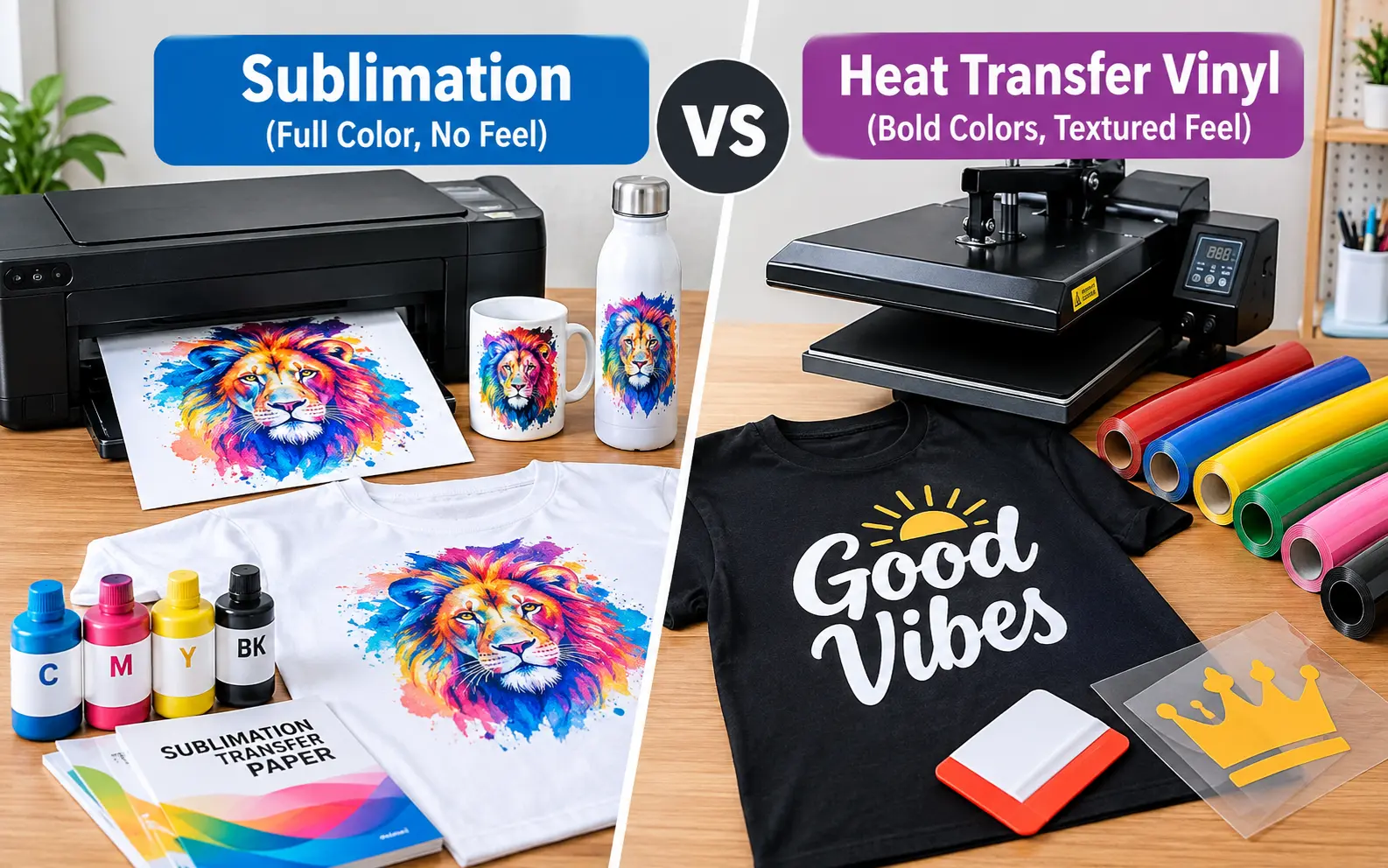
I've pressed both methods on everything from cotton tees to poly tumblers, and the "which is better" question is the wrong one to start with. The right question is what's your blank made of, and what does the finished piece need to survive. Once you answer that, the choice mostly makes itself. Here's what actually matters once you get past the basic definitions.
Fabric Compatibility Goes Deeper Than "Poly or Cotton"
Most guides stop at "sublimation needs polyester." In practice, the poly percentage matters a lot more than a yes/no answer suggests.
- 90-100% polyester: Full color saturation, sharp detail, the print looks like it was born in the fabric.
- 65-89% poly blends: Colors sublimate but come out noticeably muted, giving that soft "vintage" look some brands actually want on purpose.
- Below 50% poly: Don't bother. The dye has nowhere to bond, and you'll get a faded, patchy result that washes out within a few cycles.
HTV doesn't care about fiber content nearly as much, but it does care about surface texture. Heavily textured or ribbed knits cause poor adhesive contact, which shows up later as lifted edges around letters and small details. A smooth, tight-weave cotton or cotton-poly blend presses far more reliably than a waffle-knit or performance mesh.
The Cost Math Nobody Breaks Down
Pricing comparisons online tend to stay vague. Here's what the numbers actually look like once you factor in equipment, not just per-item cost.
| Factor | Sublimation | Heat Transfer Vinyl |
|---|---|---|
| Entry equipment | Sublimation printer (converted inkjet or dedicated model), sublimation ink, heat press | Cutting machine (Cricut, Silhouette) or standard printer, plus a heat press or iron |
| Rough startup cost | $250-$600+ for a small converted printer setup | $180-$400 for a cutting machine and starter vinyl |
| Per-item material cost | Roughly $0.30-$1.50 per design, depending on size and blank coating | Roughly $0.20-$2.00 per design, depending on vinyl type and coverage |
| Blank cost | Poly-coated blanks often cost more than plain apparel | Any standard blank works, so blank cost stays lower |
| Waste factor | Low; paper only prints what you design | Cut vinyl leaves weeding scraps you pay for but can't use |
The hidden cost most sellers miss with sublimation is ink clogging. If you don't run sublimation prints regularly, the ink sits in the print head and dries, and you'll burn through cleaning cartridges or nozzle checks just keeping the printer alive. HTV has no equivalent maintenance cost since there's no ink sitting in a machine between jobs.
Small-Batch Reality Check
If you're making one or two custom items a month, HTV usually wins on cost because there's no printer to maintain. If you're running a shop that presses daily, sublimation ink cost per print actually drops below vinyl once you're buying it in bulk.
What Actually Happens After 20+ Washes
I've tracked test shirts through repeated wash cycles, and the failure patterns are different, not just the failure timelines.
- Sublimation: Doesn't crack or peel because there's nothing sitting on the surface to peel. The most common failure is the base fabric wearing out before the print does. Color can dull slightly under harsh detergent and high heat over years, but the image itself stays intact.
- HTV: Fails at the edges first. Corners and small text lift before large solid areas do, because edges get the most mechanical stress from folding and friction. Cheap vinyl cracks in a grid pattern after repeated dryer heat; premium polyurethane-based vinyl resists this far longer.
Field Tip
Turn HTV designs inside out before drying and skip the dryer sheet on that load. Fabric softener residue is one of the most overlooked causes of premature vinyl lifting, since it coats the adhesive layer over time.
Design Limitations Each Method Has
Neither method handles every design equally well, and this is where a lot of buyers get surprised after the fact.
- Fine text under 1/4 inch: Cut vinyl struggles here because tiny letters are nearly impossible to weed cleanly. Sublimation handles small text with no weeding step at all, since it's printed, not cut.
- Photographic gradients: Sublimation wins easily; the dye blends smoothly with no visible dot pattern at close range. Printed HTV can do gradients too, but you'll often see a faint texture or sheen difference compared to sublimation's flat matte-to-fabric finish.
- Layering multiple colors: Cut HTV layers cleanly, color on color, for a raised, tactile look brands sometimes want intentionally. Sublimation can't layer this way since the dye becomes part of one flat surface.
- Dark garments: HTV, especially opaque colored vinyl, is really the only practical option here. Standard sublimation needs a light or white base to show color at all, since the dye needs a pale surface to diffuse into.
Troubleshooting Problems Competitors Don't Mention
Ghosting on Sublimation Prints
That faint double-image blur around your design usually means the paper shifted mid-press or the press released too early. Lock your paper down with heat tape on at least two sides, and hold pressure for the full press cycle instead of peeking early.
Halo Effect Around Cut Vinyl
A visible outline or shadow around your design after pressing almost always traces back to weeding residue left behind, tiny bits of vinyl backing that didn't get pulled clean. Slow down the weeding step and use a weeding hook under good light, especially on intricate script fonts.
Humidity Killing Your Press Results
Vinyl adhesive and sublimation paper both absorb ambient moisture if stored in a garage or basement. Damp vinyl presses with weak adhesion and dull edges. Store rolls and sheets in a sealed container with a small desiccant packet if your workspace isn't climate controlled.
Matching the Method to the Project
After the fabric question, this is the decision that saves the most rework:
- Team jerseys and uniforms with names/numbers: Cut HTV, hands down, for durability and clean solid color.
- Custom mugs, tumblers, phone cases, mousepads: Sublimation only; HTV won't survive dishwasher heat or curved hard surfaces the way baked-on sublimation dye does.
- All-over print apparel (full front, sleeves, seams): Sublimation, and only with large-format equipment built for panel printing before the garment is sewn.
- Small craft business selling on cotton tees: HTV or DTF, since most popular blank brands (Bella+Canvas, Gildan) run cotton or cotton-heavy blends that sublimation can't dye properly.
- One-off gifts with a photo or gradient design on a light poly shirt: Sublimation, for the smoothest hand-feel and no visible print edge.
Beginner Mistakes That Cost the Most Money
Buying a bundle of sublimation blanks before testing your printer's color calibration is the single most expensive mistake I see. Sublimation colors shift noticeably between screen, paper, and pressed fabric, so a batch of 50 uncalibrated prints can come out visibly off from your mockup. Always press one test piece before committing to a full run.
On the HTV side, the most common early mistake is pressing over a seam, pocket, or zipper. Uneven pressure at that spot means the design lifts there first, usually within the first few washes, even if the rest of the design holds fine.
Frequently Asked Questions
Can you put sublimation over heat transfer vinyl?
No. Sublimation needs direct heat contact with a poly-coated surface to bond, and a layer of vinyl underneath blocks that bond entirely. Layering works the other way: cut vinyl can go on top of a sublimated print as an accent.
Does heat transfer vinyl crack faster than sublimation?
Yes, generally. Vinyl is a physical layer sitting on fabric, so it flexes and stresses with every wash and stretch. Sublimation dye is part of the fiber itself, so there's no separate layer to crack.
What temperature do you press sublimation vs HTV at?
Sublimation typically presses around 380-400°F for 45-60 seconds on polyester fabric. HTV varies widely by brand and type, usually 305-320°F for 10-15 seconds, so always check the specific vinyl's spec sheet since formulas differ between manufacturers.
Is sublimation cheaper than HTV for a small business?
Only at volume. Low-volume sellers pay more for sublimation once you count printer maintenance and poly-coated blanks. High-volume shops see sublimation ink cost drop below bulk vinyl pricing per unit.
Can I use a regular inkjet printer for sublimation?
Not safely for long-term use. Regular inkjet printers aren't built for sublimation ink's chemical makeup, and using it can damage print heads not designed for it. Most sublimation printers are either converted (with a manufacturer-approved conversion kit) or purpose-built.
Why does my sublimation print look faded on a cotton blend?
The dye needs polyester fibers or a poly coating to bond with. A cotton-heavy blend doesn't have enough polymer content for the gas-phase dye to grab onto, so most of it never bonds and washes out fast.
Does HTV smell or off-gas after pressing?
Fresh-pressed vinyl can carry a mild plastic smell for the first wash or two, especially with lower-quality PVC-based vinyl. Polyurethane vinyl tends to have less odor. Sublimation carries little to no lingering smell since the dye fully bonds into the fabric during the press.
Which method is better for beginners with a Cricut or Silhouette?
HTV is the more natural starting point for cutting machine owners, since that's exactly what those machines are built to cut. Sublimation requires a separate printer investment and doesn't use the cutting machine at all beyond trimming paper.