
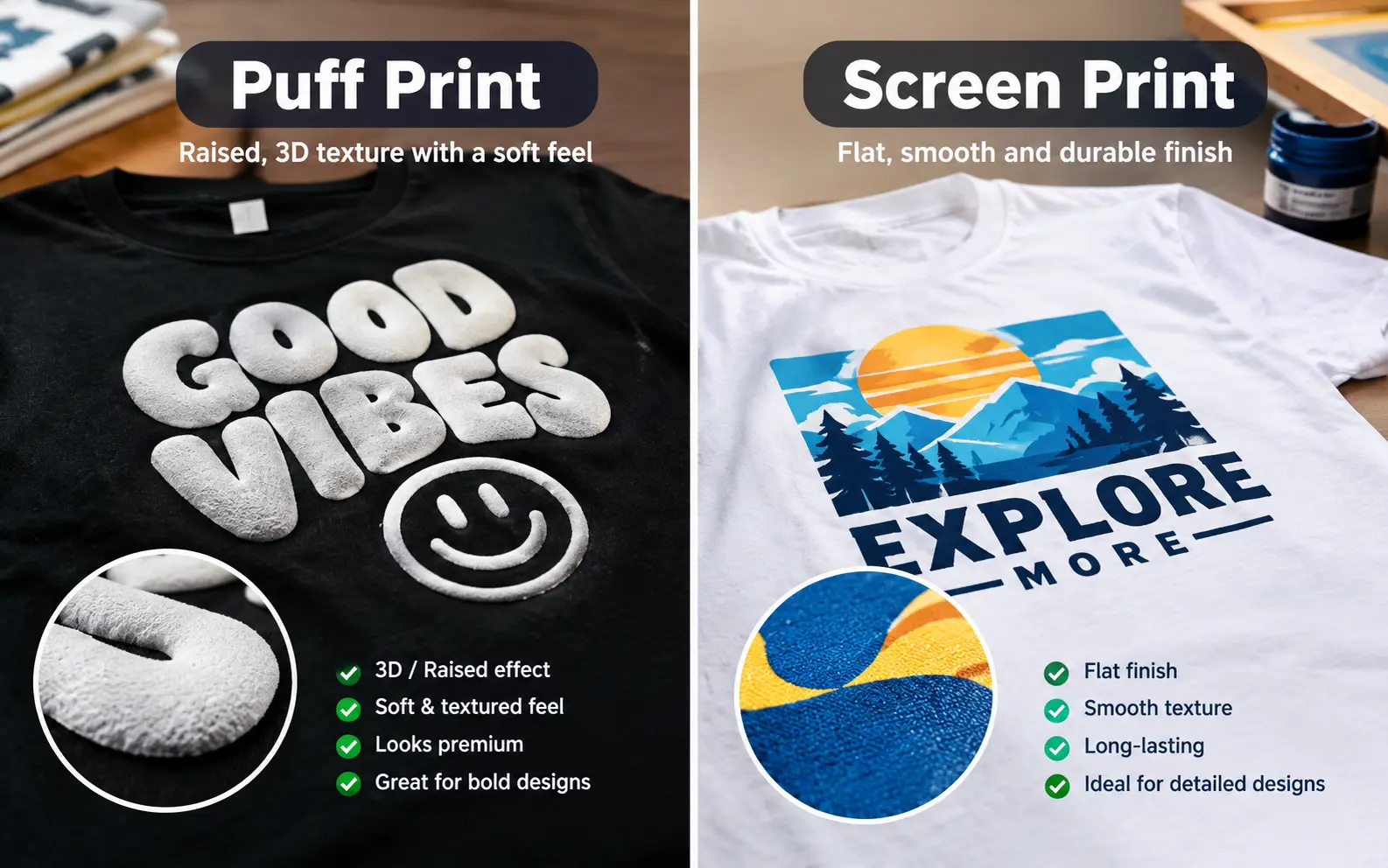
Every few weeks someone sends us a flat logo file and asks for it "with a puff effect." Sometimes that works. Usually the file needs rework first, because what looks fine on a screen can fill in completely once the ink rises in the oven.
This guide is about that gap, and how to close it before you pay for a bulk run.
Puff print is a screen printing variation that uses a foaming additive, so the ink swells under heat into a soft, raised surface, while standard screen print stays flat. Choose puff for bold lettering and simple shapes where texture is the whole point. Choose standard screen print for fine detail, several colors, tight color matching and large repeat runs.
Will Your Artwork Survive the Puff?
Puff ink grows outward as well as upward. Thin gaps close, small enclosed spaces fill in, and sharp corners turn soft.
These are the limits we work to when we check a file:
- Line weight: Keep strokes at 1 pt (about 0.35 mm) or heavier. Anything thinner tends to swell shut.
- Letter counters: The enclosed spaces in A, B, O, P and R need generous room, or they clog.
- Halftones: If the design uses them, go no finer than 20 lines per inch.
- Spacing: Give neighboring shapes extra clearance, because the ink spreads sideways as it rises.
- Height: Expect roughly 1 to 2 mm of rise on a typical build.
Photographic work is the clearest mismatch. Puff needs a heavy ink deposit, so shops usually run a coarse screen, often in the 86 to 110 mesh range with thicker emulsion. Photos need a much finer mesh, so the two goals work against each other.
The most common mistake we see is reusing the flat-print file. Thicken the strokes, open the counters and cut the clutter before any screens are made. Some printers can lower the rise height as a compromise for detailed art, but that depends on how well they have dialed in their process.
Why Puff Colors Rarely Match Your Brand Swatch
Mixing pigment into a puff base dilutes it. After expansion, the color usually lands a shade or two lighter than the same ink printed flat.
That matters if your logo has a strict Pantone reference. A printer can compensate by adjusting the mix, but it takes sample rounds, so tell them early how exact the match needs to be.
Approve a puff strike-off in your real color, and look at it in daylight, not under shop lights. Tone-on-tone designs hide the shift best, since the texture carries the design instead of the color contrast.
What Your Garment Does to the Print
The blank you pick can make or break a raised graphic. We treat fabric as part of the print spec.
- Fabric weight: Cotton tees around 220 to 280 GSM, French terry and brushed fleece are solid starting points. A big raised graphic on thin jersey can pull the fabric inward and change how it drapes.
- Stretch zones: Ribbing, side seams and athletic knits crack raised ink. Flat ink or a stretch-formulated ink is safer there.
- Seams, pockets and zippers: Raised ink printed across an uneven surface distorts. Keep puff on a flat panel.
- Polyester: Polyester-rich fabric can bleed dye into light inks, so it needs ink chosen to manage dye migration. Ask for a test on the actual fabric.
- Garment-dyed and washed pieces: Pigment dyeing and heat treatments can change how a print behaves. Confirm whether printing happens before or after the wash.
Never judge puff on a generic cotton swatch. Puff height on a heavyweight fleece hoodie behaves nothing like it does on a lightweight tee.
Where the Money Actually Goes
Price follows screens, test cycles, cure control and quantity. The method name matters less than the artwork you send.
Take two jobs. A one-color puff wordmark needs a single screen. A six-color illustrated back print needs six screens plus registration time, which is why the simple puff job can quote lower than the big flat one.
Puff turns expensive when it needs extra swatches, additive adjustments and rework. Small runs feel that most, because setup is spread over few pieces.
Ask every supplier to quote your exact artwork at several tiers. Price breaks commonly fall around 50, 100, 250 and 500 units.
How Prints Fail, and How to Catch It Early
Most failures trace back to the oven or the deposit, not the ink brand.
- Under-cure: Puff flattens quickly and cracks at the edges.
- Over-cure: The print turns brittle or collapses.
- Too much additive or a heavy deposit: Raised ink cracks along flex lines.
- Stretch placement: Both finishes crack when printed over high-stretch zones.
A fresh print off the press tells you nothing. This is the routine we recommend before approving bulk:
- Request a strike-off on the real production fabric.
- Measure the puff height before washing.
- Wash it 20 times, inside out, cold, on a gentle cycle.
- Check for cracks, lost loft, edge clarity and color change.
- Write down pass or fail criteria before bulk production starts.
Properly cured puff can hold its texture beyond 10 washes, so 20 is a deliberately strict bar. Pick the bar that matches how hard your customers will actually use the garment.
One last thing we watch is packing. Heavy stacks can press a raised graphic flat before it ever reaches a customer, so we fold puff pieces with the print area uncreased and keep them off the bottom of the box.
Using Both on One Garment
Mixing finishes is often the smartest answer. Flat ink holds the detail, and puff ink adds texture to the one element that deserves it.
A typical build is a large illustrated back print in flat ink with the brand name in puff. The two inks are printed side by side, so leave extra clearance around the puff areas.
Test the full design together, since print order and curing can affect the result. And resist puffing every element: too much raised ink feels stiff, heavy and crowded.
When You Want the Look Without Screen Setup
Standard DTF prints flat, so a true puff effect with standard DTF equipment is not currently possible. These are the raised options that do exist.
| Option | Raised effect | Best for | The catch |
|---|---|---|---|
| Puff screen print | Strongest, soft and rounded | Bold logos on runs that justify setup | Needs screens and test swatches |
| Puff screen print transfers | Strong, pressed on later with a heat press | Shops with a press, repeat designs, volumes from roughly 50 pieces | Setup fees hurt at low volume |
| Puff heat transfer vinyl | Raised but less pronounced | Names, numbers, bold shapes, tiny runs | Cut and weeded by hand, fine detail will not expand evenly |
| Puff (3D) embroidery | Structured and defined | Caps and hats | Stitched, so the look is different |
| High-density print | Raised, built in layers | Limited solid colors | Needs sturdy cotton and several cure stages |
Press temperatures for puff transfers and vinyl are commonly quoted between 320 and 400 °F. Always follow the supplier's own spec.
Quick Decision Table by Scenario
If your situation is on this list, the answer is usually short.
| Scenario | Better pick | Why |
|---|---|---|
| Heavyweight hoodie with a big block wordmark | Puff | Thick fabric balances the raised ink |
| Detailed back illustration with small text | Standard screen print | Fine lines survive |
| Logo that needs an exact brand color | Standard screen print | No lightening after expansion |
| 500-piece core tee run | Standard screen print | Predictable repeats and lower cost |
| Limited drop with one hero logo | Puff | Texture becomes the selling point |
| Thin jersey or stretchy activewear | Standard screen print | Less cracking and drape change |
| Illustration with one hero word | Both | Flat detail plus a raised accent |
| Photographic artwork | Neither | A digital method such as DTG fits better |
Questions to Ask Your Printer Before You Approve
A good printer answers these without hesitating. A vague answer tells you how much puff work they really do.
- Mesh and emulsion: Which mesh count and emulsion thickness do you use for puff jobs?
- Additive ratio: How do you set the additive percentage for my fabric?
- Cure profile: What temperature and dwell time do you run, and how do you verify it?
- Sample policy: Will you run a strike-off on my fabric, and can I wash it before I approve?
- Failure criteria: What counts as an unacceptable crack or loss of loft in a batch?
A printer who refuses a swatch on your fabric is a red flag.
Our Short Recommendation
Use flat screen printing as the base for anything that has to be read or color-matched. Add puff only where texture earns its place, and prove it with a washed strike-off before the bulk order goes in.
Frequently Asked Questions
Can you puff print on polyester or performance fabric?
Yes, puff ink can be applied to polyester and blends. Stretchy knits risk cracking, and polyester may need dye-migration control, so ask for a test on the exact fabric. For activewear, flat print with a stretch-friendly ink is usually the safer route.
Is puff print safe for kids' clothing?
It can be, when the printer uses inks that comply with CPSIA rules in the United States and are free of lead and phthalates. Keep the raised areas small on children's pieces so thin fabric does not go stiff.
Can I iron or tumble dry a puff print?
Do not iron directly on the print. If you must press the garment, use a cloth or turn it inside out, and hang dry or use low heat to protect the raised surface.
Does puff print feel scratchy against the skin?
It usually feels soft and cushioned, closer to foam than to a hard coating. A large solid puff area can still feel stiff on a thin shirt, so ask for a physical sample before committing.
Does puff print photograph well for online stores?
Raised ink catches light and throws small shadows, so it looks different from one angle to the next. Shoot with soft side light and add a close-up so shoppers see the texture. Flat prints photograph cleaner at any scale.
Can puff work on a small chest logo?
It can, if the lettering is bold and the counters stay open. Thin letters at small sizes fill in, so check the actual print size on a strike-off rather than a mockup.
Does puff print automatically look premium?
No. A clean flat print beats a poorly controlled puff print every time. Puff reads as premium only when the artwork, fabric and cure are all dialed in.
Can I get puff print in metallic or neon colors?
Yes. Puff additive can be mixed with many inks, so white, color, metallic and neon puff are all possible. Request a swatch in the exact shade, since puff color shifts from the flat version.