
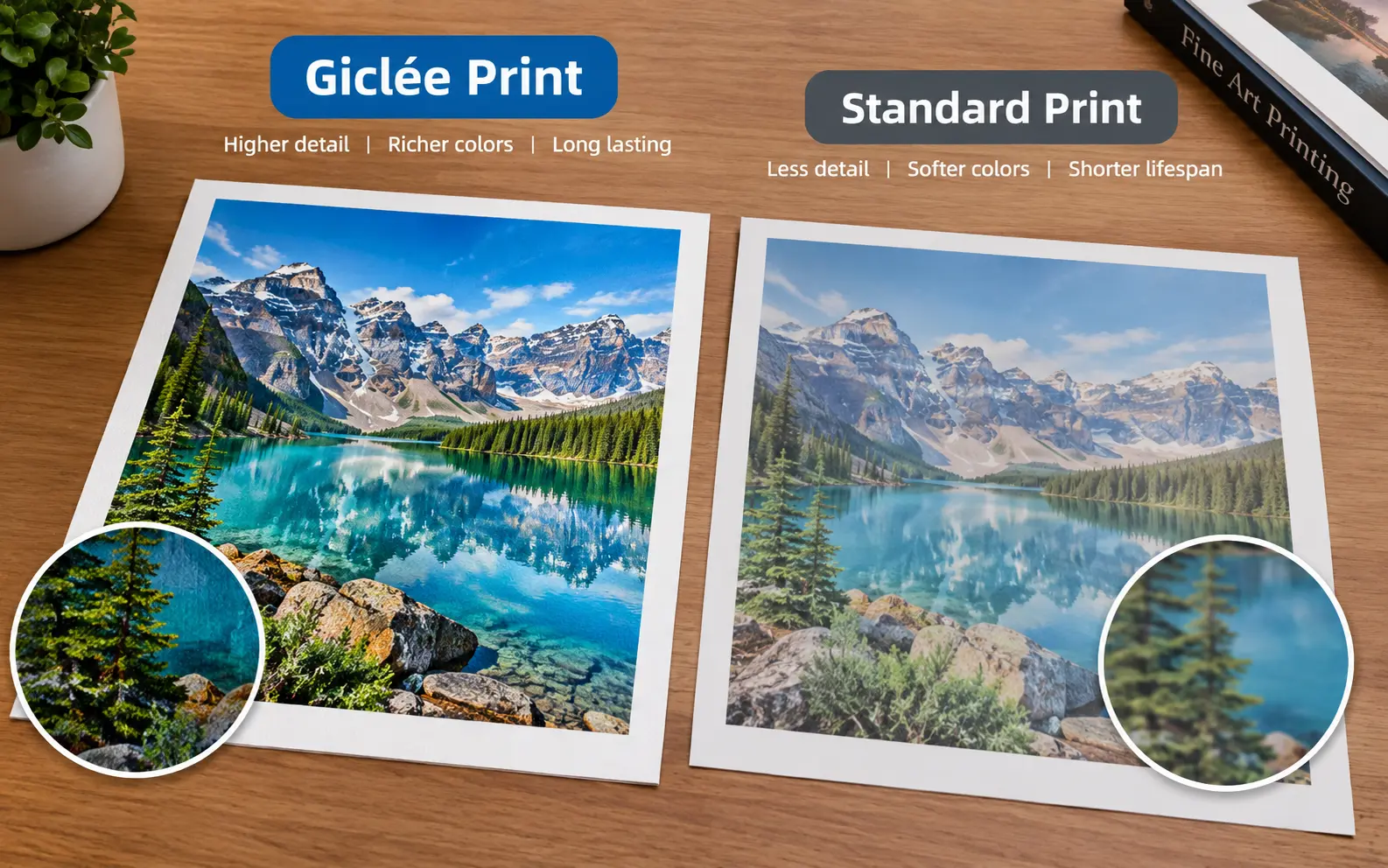
If you have ever stood at a print lab's order screen wondering whether the giclée option is worth three times the price, you're not alone. Most guides answer that question with marketing. This one answers it with the details that actually decide how your print looks today and how it looks in 30 years.
A giclée print is a fine art inkjet print made with pigment inks (usually 8 to 12 colors) on acid-free cotton or alpha-cellulose paper or canvas, which gives it wider color range and far better fade resistance. A standard print is usually a chemical photo print, a 4-color inkjet, or a laser/offset print on resin-coated or ordinary paper, which costs much less and looks great short term. Choose giclée for art you'll display for decades or sell as a reproduction; choose standard for snapshots, gifts, proofs, and décor you'll swap out.
"Standard Print" Isn't One Thing
This is where most comparisons go wrong. When a lab or shop says "standard," it could mean any of four very different processes, and they don't age the same way.
| Print type | How it's made | Typical paper | Where it shines | Main weakness |
|---|---|---|---|---|
| Giclée (fine art inkjet) | Wide-format printer, 8 to 12 pigment inks | Cotton rag, alpha-cellulose, canvas | Art reproduction, gallery display | Cost, delicate matte surface |
| C-type / silver halide | Light exposes chemical photo paper, then wet processing | Resin-coated (RC) photo paper | Photos, punchy gloss, low cost per print | Shorter display life than pigment |
| Consumer inkjet | Home or office printer, often 4 dye inks | Plastic-backed glossy or plain paper | Quick prints at home | Fading, visible dots, weaker color |
| Laser / offset | Toner or printing plates, CMYK | Coated poster stock | Posters, flyers, high volume | Limited color, low archival value |
The C-type row matters most for photographers. Your 4x6 and 8x10 lab prints are almost always chemical prints, not inkjet, so they deserve a fairer comparison than "cheap inkjet."
Where the Quality Gap Actually Shows Up
Ink chemistry does the heavy lifting
Pigment inks are tiny solid particles that sit on top of the paper's coating. Dye inks and chemical photo dyes are dissolved color, which breaks down faster under light and air pollution. That single difference explains most of the longevity gap.
Paper decides both the look and the lifespan
Giclée papers are usually 100% cotton rag or alpha-cellulose, with no acid and ideally no optical brighteners. Standard photo papers are coated with plastic on both sides. PermaJet points out that papers with a plastic PE backing don't qualify as giclée substrates, even when manufacturers publish print-life figures of 100 years or more for them.
More inks mean smoother gradients
Extra light-cyan, light-magenta, gray, and specialty inks let the printer blend tones without visible dots. FeatherJoy's side-by-side test is a good real-world example: the 11-ink giclée kept the water green, as in the original painting, while the 4-ink home print pushed it toward blue. That kind of shift is what you notice in skies, skin tones, and watercolor washes.
The Longevity Numbers, Decoded
You'll see "100 years," "200 years," even "400 years." All of those can be true, but only under specific test conditions.
- The main independent tester is Wilhelm Imaging Research (WIR). Its ratings assume about 450 lux of light for 12 hours a day and measure the years until fading or color shift becomes easily noticeable.
- Current pigment inks top the charts. Epson's UltraChrome HD and HDX inks earn WIR ratings of up to 200 years, depending on the paper.
- Chemical photo prints fall well short. WIR founder Henry Wilhelm has said that dye-sublimation metal prints rated around 50 years last more than twice as long as Kodak and Fuji silver-halide color prints.
- Glass roughly doubles the life of a print. In one WIR result, a pigment print on fine art paper was rated 108 years under glass but only 57 years unframed.
- Big numbers need extra testing behind them. WIR won't give any print a rating above 100 years unless dark-storage tests also support it. So if a seller quotes 200 years with no source, ask where the figure came from.
The practical takeaway is simple. A framed giclée in a normally lit hallway will likely outlast you. A framed C-print in the same spot may start to shift within a couple of decades.
When a Standard Print Is the Smarter Buy
I've seen people pay giclée prices for prints that didn't need it. A standard print is the better choice when:
- You're printing photos for albums, fridges, or desk frames. A lustre C-print costs a fraction as much and looks sharp at arm's length.
- You want high-gloss punch. Glossy photo paper produces deeper-looking blacks than matte cotton rag.
- You need volume. Event handouts, proof sets, and school photos don't need archival materials.
- The décor is temporary. Kids' rooms, rentals, and seasonal walls change long before fading becomes an issue.
- The source file is weak. A low-resolution phone photo won't gain much from premium paper. The file is the bottleneck, not the print.
The Downsides of Giclée Nobody Mentions
- Matte surfaces are fragile. Uncoated cotton rag scuffs and shows fingerprints, so handle it by the edges or with cotton gloves.
- Matte blacks look softer. Matte fine art paper can't hit the deep black of glossy paper. It reads as painterly, which suits artwork but can disappoint on high-contrast photography.
- Color can drift between batches. As noted above, the printers need regular calibration, and even humidity and temperature can shift color. If you reorder a print a year later, ask for a match to your approved proof.
- The label is unregulated. One London framer notes that "giclée" began as a marketing term and only later became shorthand for a quality benchmark. Nothing legally stops a shop from printing on cheap paper and calling it giclée.
How to Tell If a "Giclée" Is the Real Thing
Before you pay a giclée price, ask the seller these five questions. A reputable printer will answer all of them in under a minute.
Which printer and ink set do you use?
Look for a pigment system such as Epson UltraChrome, Canon LUCIA, or HP Vivera.
What is the exact paper name?
"Hahnemühle Photo Rag 308" is an answer. "Premium archival paper" isn't.
Does the paper meet Fine Art Trade Guild standards?
The Guild's criteria require a Blue Wool lightfastness score of 6 or higher across the whole print, and a paper pH between 7 and 10.
Is the image scanned or photographed from the original, and at what resolution?
Poor capture ruins even the best printer.
Can I see the paper texture in person or in a close-up?
Real cotton rag has a soft, slightly fibrous surface, with no plastic sheen on the back.
Quick physical check: flip the print over. A slick, plastic-feeling back points to RC photo paper, not fine art stock.
What Each Option Typically Costs
Prices vary a lot by lab and region, so treat these as rough US ballparks from typical online labs:
- 8x10 standard photo print: usually a few dollars
- 8x10 giclée on cotton rag: roughly $20 to $45
- 16x20 standard print: often $10 to $25
- 16x20 giclée: commonly $50 to $120 before framing
The gap narrows once you add framing, since a good frame often costs more than either print. If you're already paying for archival framing, pairing it with a standard print is usually the false economy.
For Artists Selling Prints
Get the capture right first
Scan flat work at a high resolution, ideally at least 300 ppi at the largest size you plan to sell. Textured paintings often need raking-light photography or a dedicated art scanner. Then always order a test proof and compare it to the original under daylight-balanced light before you approve an edition.
Be honest about editions
A giclée can be reprinted indefinitely from the same file. That makes a limited edition a promise you keep by choice, not a physical limit. Record edition sizes, sign and number consistently, and don't quietly reissue a "sold-out" image at a new size.
Check disclosure rules
Some US states, including California and New York, have fine print disclosure laws that can require certain information when you sell limited-edition multiples above a price threshold. Rules vary, so check your state's requirements (or ask a lawyer) before you label and price an edition.
Offer both tiers
Many working artists sell open-edition standard prints at an impulse price alongside signed giclée editions at a collector price. That captures both buyers without undercutting either.
Making Either Print Last Longer
- Frame behind UV-filtering glazing. It's the single biggest longevity upgrade for any print type.
- Use acid-free mats and backing. Cheap cardboard backing can yellow the print from behind.
- Avoid direct sun, bathrooms, and kitchens. Humidity and cooking fumes speed up damage.
- Never laminate a giclée. Lamination can't be reversed and removes its value as fine art.
- Store unframed prints flat in archival sleeves, interleaved with acid-free tissue.
Frequently Asked Questions
Can I make a giclée print at home?
Yes, if you have a pigment-ink photo printer (typically 8 or more inks) and genuine archival fine art paper. The result can be true giclée quality, but you'll also need color management, including a calibrated monitor and the paper's ICC profile, to get accurate color.Is a giclée print considered original artwork?
No. It's a reproduction of an original. Hand-pulled etchings, woodcuts, and screen prints made directly by the artist count as original prints; giclées don't, even when they're signed.Do giclée prints go up in value?
Rarely, on their own. Value depends on the artist's reputation, the edition size, and demand. A signed, small-edition giclée from an established artist can hold its value, while open editions generally won't appreciate.Can a phone photo be printed as a giclée?
It can, but keep the size modest. Most modern phone images hold up well to about 8x10 or 11x14, and pushing larger usually exposes noise and softness that fine art paper makes more visible, not less.Is giclée on canvas better than giclée on paper?
Neither is better; they suit different work. Canvas mimics the texture of a painting and can hang without glass. Paper holds finer detail and suits watercolors, drawings, and photography, but it needs framing behind glazing.Can giclée prints be glossy?
Yes. Many labs offer giclée on baryta, lustre, or gloss fine art papers. You get pigment-ink longevity with more contrast and deeper blacks than matte cotton rag.Is a giclée worth it as a gift?
For a meaningful piece the person will hang for years, such as a wedding photo or a favorite artwork, yes. For casual photos or seasonal décor, a quality standard print framed well is the better use of money.