
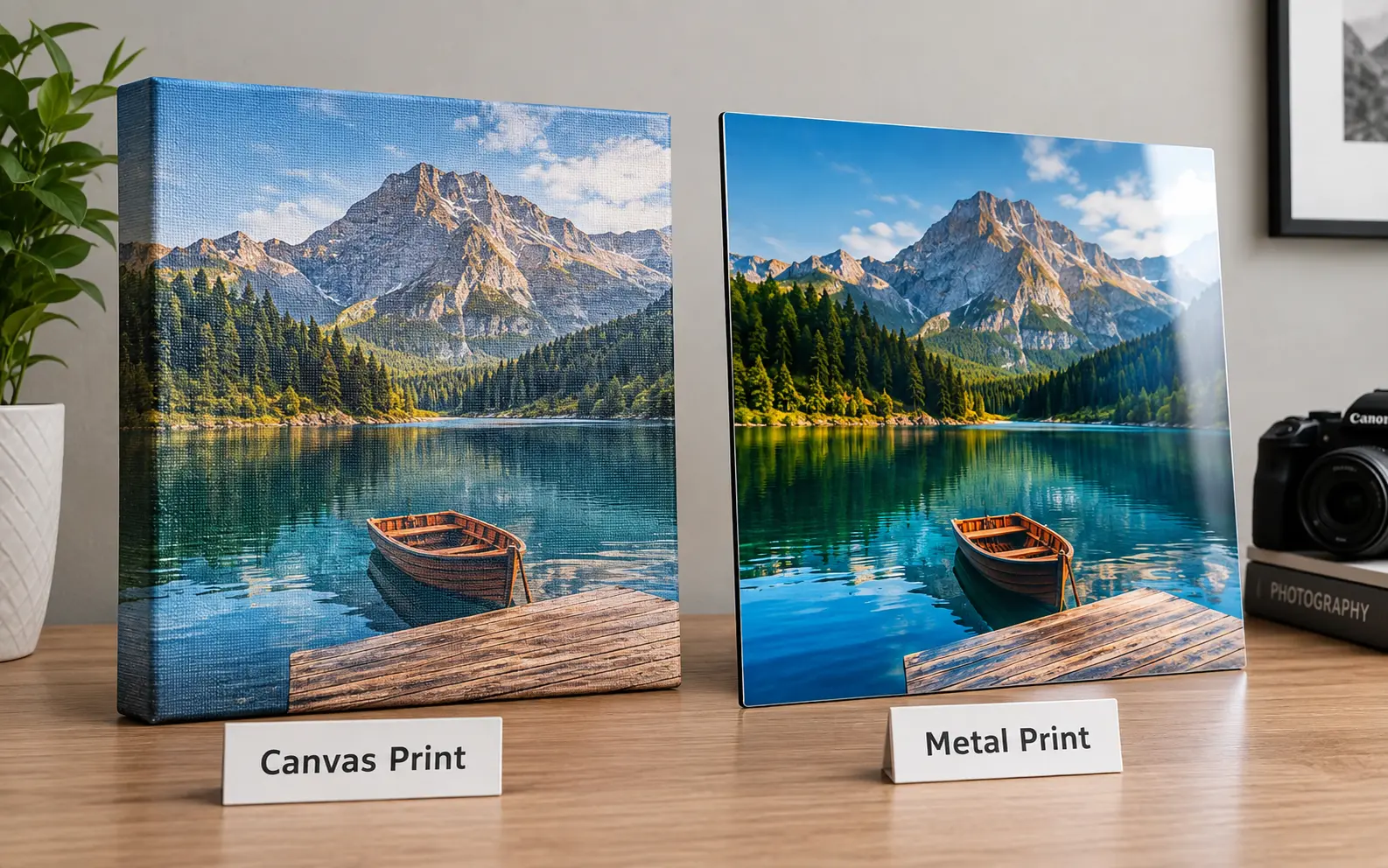
You've got a photo you love and a bare wall waiting for it. Now you're stuck on one decision that changes everything about how that image will look for the next decade.
Pick a canvas print if your photo is a portrait, a soft or warmly lit scene, or an image that isn't perfectly sharp, and it's going into a normal living space. Canvas is cheaper, glare-free, and forgiving. Pick a metal print if your photo is sharp, colorful, and high-contrast (landscapes, cityscapes, night scenes), or if it's hanging somewhere humid. Metal costs roughly 2 to 4 times more, but it delivers punchier color and wipes clean.
| Factor | Canvas Print | Metal Print |
|---|---|---|
| Look | Soft, textured, painterly | Crisp, luminous, modern |
| Glare | Very low | Moderate to high (finish dependent) |
| Tolerance for imperfect photos | High | Low |
| Humidity and moisture | Poor | Excellent |
| Cleaning | Dry dusting only | Damp microfiber cloth |
| Typical 16x20 price | About $15 to $60 | About $60 to $150 |
| Best rooms | Living room, bedroom, hallway | Kitchen, bathroom, office, modern spaces |
Start With the Photo, Not the Material
Most people choose a material first and then pick a photo to fit it. Flip that around. Your file quality and subject matter decide the result more than any product page will.
Canvas texture acts like a gentle filter. It hides sensor noise, mild blur, and compression artifacts, which is why an older phone photo can look lovely on canvas. Metal does the opposite. Its smooth, reflective surface magnifies every flaw, including over-sharpening halos and banding in skies.
Here's a rough guide to the pixel dimensions you want before ordering:
| Print Size | Canvas (about 150 PPI) | Metal (about 200+ PPI) |
|---|---|---|
| 11x14 | 1650 x 2100 px | 2200 x 2800 px |
| 16x20 | 2400 x 3000 px | 3200 x 4000 px |
| 20x30 | 3000 x 4500 px | 4000 x 6000 px |
| 24x36 | 3600 x 5400 px | 4800 x 7200 px |
Practical takeaway: A typical 12 MP phone photo (about 4000 x 3000 px) handles a 16x20 metal print comfortably. At 24x36, stick with canvas unless the shot is exceptionally clean. A 24 MP camera file has headroom for metal up to about 20x30.
One more nuance: people view large prints from farther away. A good rule of thumb is that normal viewing distance is about 1.5 to 2 times the print's diagonal. That's why a big canvas can get away with lower PPI than you'd expect.
The Finish Choice Nobody Explains Properly
When someone says "metal is too shiny" or "canvas looks dull," the real culprit is usually the finish option, not the material itself.
Metal comes in two base types:
- White metal (white-coated aluminum): Colors and skin tones stay true. This is the right choice for about 90% of photos.
- Clear or brushed metal: The raw aluminum shows through every light area of the image. It looks stunning on cars, architecture, and moody black-and-white shots, but faces turn grey and metallic. Never choose clear metal for portraits.
Metal surface finishes:
- High gloss: Maximum color depth and the most reflection.
- Satin or luster: Most of the punch with far less glare. This is the safest default for homes.
- Matte: Rare, but it exists. Some labs, like CanvasDiscount, print metal with a matte finish only. Check before you order if you expect gloss.
Canvas finishes vary too. Some labs add a satin laminate for protection and a slight sheen, while others leave canvas fully matte. If your room gets strong direct light, ask for matte.
Your Room's Light Will Make or Break a Metal Print
This is the step I'd never skip. A glossy metal print on the wrong wall becomes a mirror for your window.
The two-minute glare test:
- Stand where you'll normally view the print, such as the sofa or the doorway.
- Have someone hold a phone screen or small mirror flat against the wall at the exact hanging spot.
- Whatever you can see reflected in that surface is what you'll see in your metal print.
If a window, TV, or ceiling light shows up, either choose a satin finish, pick a different wall, or go with canvas. Canvas passes this test almost everywhere because its texture scatters light instead of bouncing it back.
Lighting tip: If you use a picture light or track spotlight on metal, angle it at roughly 30 degrees from vertical. Lights aimed straight at a glossy surface create a hot spot. Canvas handles direct spotlighting beautifully, and it's one of the few situations where canvas looks more dramatic than metal.
Edit Your File Differently for Each Material
Your screen is backlit. Prints aren't. That gap hits each material differently.
For canvas:
- Canvas absorbs light and prints darker and flatter than your monitor shows.
- Lift the midtones slightly and add a touch of contrast before uploading.
- Go easy on sharpening. The texture will soften details anyway, and heavy sharpening shows up as crunchy edges.
For metal:
- Metal exaggerates contrast, so deep shadows can block up into solid black.
- Check that dark areas still show detail, and pull back any highlights that are close to clipping.
- Skies with smooth gradients can show banding. A tiny amount of noise added in editing often hides it.
The gallery wrap trap (canvas only): On a wrapped canvas, part of your image folds around the frame edges. On a 1.5-inch deep canvas, you lose about 1.5 inches on every side of the visible face. Keep heads, horizons, and text well away from the edges, or choose mirror wrap or solid color edges so nothing important disappears.
Durability in Real Homes, Not Product Descriptions
Both materials last years indoors. The differences show up in specific situations.
- Humid climates and coastal homes: Canvas can loosen and ripple as humidity swings. Metal doesn't care.
- Kitchens: Cooking grease settles on everything. You can wipe metal clean, but canvas traps grease in its weave, and that's hard to fix.
- Bathrooms: Metal is fine. Canvas near a shower tends to warp or develop spots over time.
- Sunny walls: Neither material is fade-proof. Dye-sublimated metal generally holds color longer, but hours of daily direct sun will fade both.
- Kids and pets: Canvas can be punctured by a thrown toy or a curious paw. Metal won't tear, but its corners can dent if dropped, and a dent can't be fixed.
- Outdoor patios: Metal survives rain, but constant UV and temperature swings shorten its life noticeably unless the lab sells an outdoor-rated version.
How to verify longevity claims: Ask the lab if its materials have been tested by an independent lab such as Wilhelm Imaging Research. Published test results mean more than "lasts a lifetime" on a product page.
Hanging, Weight, and Installation
Competitors disagree on which material is heavier, and that's because it depends on the build. A thin 0.045-inch aluminum panel is very light. A composite metal panel, or any metal print with a float mount attached, can weigh more than a canvas of the same size.
What matters in practice:
- Canvas usually has a sawtooth hanger or wire. One nail or hook works for small and medium sizes, and it's the easiest option for renters.
- Metal usually has a float mount, a block on the back that makes the print hover off the wall. It hangs on a single screw, so it must be leveled precisely. A float mount is less forgiving than a wire.
- Standoff mounts (metal posts at each corner) look sleek but need four accurately drilled holes.
- For anything over 24x36, use wall anchors or a stud for either material.
What You'll Really Pay
The sticker price isn't the full cost.
- Canvas extras: An optional floater frame can double the price. Thicker 1.5-inch wraps cost more than 0.75-inch wraps.
- Metal extras: Some labs charge separately for the float mount or hanging hardware. Oversized metal pieces can also carry extra shipping costs.
- Sale cycles: Both materials are heavily discounted in regular promotions. Paying full price for either is rarely necessary if you can wait a few weeks.
A smart budget move: If you want one statement piece, put your money into a metal print of your single strongest image and use canvas for supporting pieces. Keep finishes consistent within one sightline, though. A glossy metal print hanging right next to a matte canvas can look accidental rather than intentional.
A 5-Question Test to Decide in Two Minutes
Answer honestly, and follow the majority.
- Is the photo tack-sharp and noise-free at your chosen size? Yes leans metal. No leans canvas.
- Is the subject mainly a person or people? Yes leans canvas.
- Did your wall fail the glare test? Yes leans canvas, or satin metal.
- Is the room humid, greasy, or high-traffic? Yes leans metal.
- Is your decor modern, minimal, or industrial? Yes leans metal. Warm, rustic, or traditional decor leans canvas.
Still split? Order an 8x10 of the same image in both materials. It costs roughly $40 to $50 total and removes all guesswork before you commit to a large piece.
Mistakes I See Most Often
- Printing a dark, moody photo on canvas without brightening it. It arrives looking muddy.
- Choosing clear metal for a family portrait because it sounded premium.
- Ordering a huge metal print from a cropped phone photo, which leaves every pixel visible.
- Hanging glossy metal opposite a window without testing the wall first.
- Losing someone's forehead in the gallery wrap edge.
- Cleaning canvas with a wet cloth, which can leave water marks or lift the coating.
Frequently Asked Questions
Are metal prints magnetic?
No. Most are printed on aluminum, which isn't magnetic, so fridge-style magnets won't stick. Some mounting hardware on the back may be steel, but the printed panel itself won't attract magnets.Can you put a frame around a metal print?
Yes. Many labs offer floater frames for metal, and a local framer can add one too. Most people skip framing because metal already looks finished, but a thin black or wood frame can help metal fit a more traditional room.Is canvas or metal the better gift if I don't know the recipient's decor?
Canvas is the safer bet. It blends with more interior styles and hangs easily on a single nail. Metal can clash with rustic or cottage-style homes.How do I fix a canvas print that has started to sag?
Check the back corners for small wooden wedges called stretcher keys. Tapping them gently outward re-tightens the canvas. If there are no keys, contact the lab. Many will re-stretch or replace a sagging print under warranty.Is it safe to hang either type over a bed or crib?
Canvas is the gentler choice because it's lighter and has no hard edges. If you choose metal, anchor it into a stud or use rated wall anchors. Avoid heavy pieces above a crib entirely, especially in earthquake-prone areas.How should I pack a canvas or metal print when moving house?
Wrap metal in soft foam or a blanket and protect the corners with cardboard, since corners dent first. For canvas, place stiff cardboard against the front so nothing can press into the fabric. Always store both upright rather than flat under other boxes.Do metal prints look good on dark painted walls?
Very good, actually. A white-base metal print glows against navy, charcoal, or deep green walls, and the contrast makes colors look even more vivid. Canvas on dark walls reads warmer and more subdued.